ANALYSIS
Two F-16 Block 70s begin Chihhang conversion, not a full wing
Two new-build F-16 Block 70 fighters are at Chihhang in Taiwan for acceptance and conversion training, while 63 aircraft remain in United States production.
TAIPEI —
This article is an original Taiwan Defence analysis based on the cited public sources. It distinguishes reported facts from analytical judgments and does not represent original field reporting.
What arrived
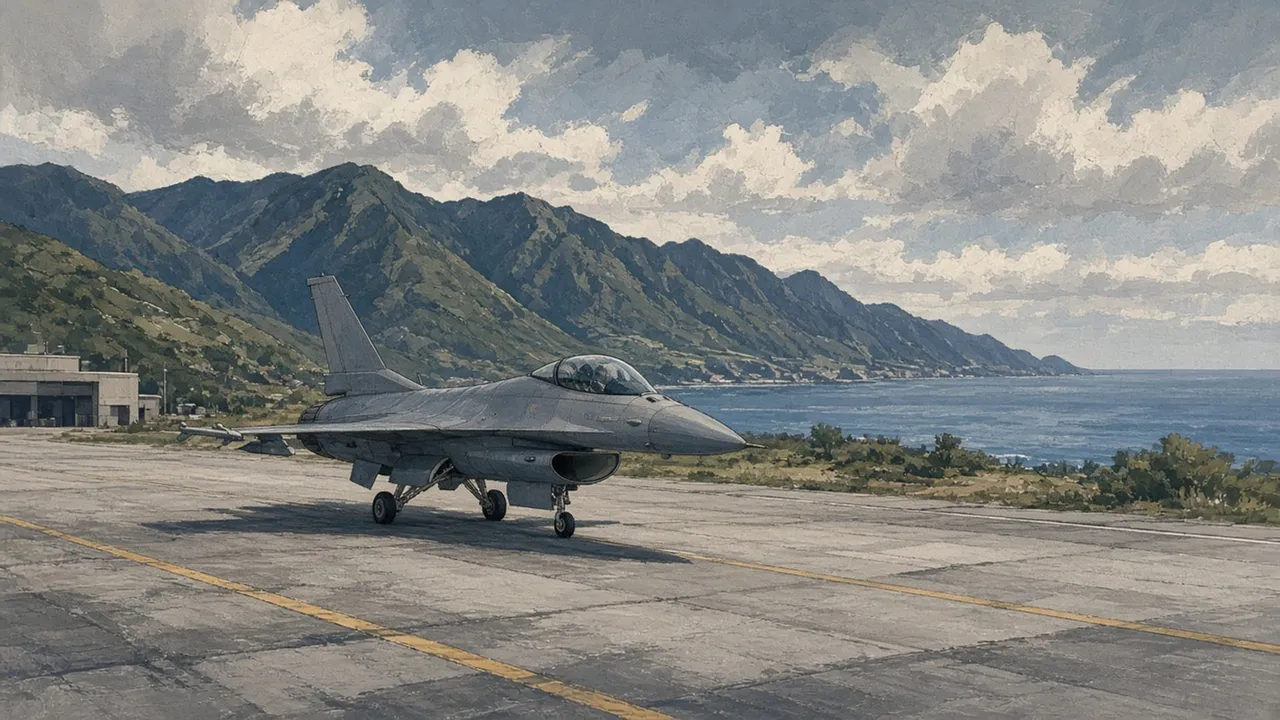
On 2 October 2026 the Republic of China Air Force Command said the first two single-seat F-16 Block 70 fighters had landed at Chihhang Air Base in Taitung. Focus Taiwan reported that the aircraft, tail numbers 6727 and 6728, arrived around noon after departing Hawaii and stopping in Guam. Breaking Defense, citing photographs released by the Military News Agency, reported the same serial numbers and the same eastern airfield. The command statement, the news-agency account and the specialist report therefore agree on the central fact: two new-build Block 70s are now on Taiwanese territory at Chihhang.
The Air Force Command said it will carry out planned acceptance and conversion training and will move other preparations forward in sequence so that combat power forms gradually. That wording is narrower than a claim of immediate operational readiness. The statement does not give a date on which the two aircraft will hold alert, fly air-defence patrols, or join a daily scramble roster. It describes work that starts with acceptance, not a finished squadron.
A wing that is still being built
The same statement says the 7th Tactical Fighter Wing was established on 1 December 2023 to strengthen overall air defence. Squadrons of that wing are being formed in three phases, and aircrew and maintenance personnel have been sent to the United States in batches for conversion training. As further aircraft return, those people are expected to take up acceptance work so the new fighters can be brought into use. The command has not said how many crews have finished that training, or how many of them are already back at Chihhang.
The command said 63 Block 70 aircraft remain on the United States production line and that some of them have reached the delivery stage. Later flights home, it said, will be managed against the schedule set with the United States programme office. Focus Taiwan reported that Defence Minister Wellington Koo, speaking at the Legislative Yuan the same day, said more than two jets would be delivered during 2026 and that subsequent dates would be set with the United States. He did not publish a month-by-month plan.
Focus Taiwan also reported that Koo described eastern Taiwan as an important place to preserve combat power, consistent with military strategy, and that he declined to go further. The command statement names Chihhang as the airfield that received the first pair. It does not state that every later Block 70 will be based there, and it does not give a date for full wing strength. Public evidence currently supports one arrival base and ministerial emphasis on the east, not a complete basing map.
A late order, with an unresolved hold
Focus Taiwan reported that Washington approved the sale of 66 F-16V aircraft and related equipment in 2019 for about US$8 billion, with delivery once expected to begin in 2023 and to finish in 2026, before technical problems pushed the timetable back. Breaking Defense added an industrial account that is not in the Air Force Command statement: assembly moved from Fort Worth to Greenville, and supply-chain shortages later added another delay. The 2019 approval, the size of the order and the slipped timetable are taken here from Focus Taiwan. The factory history is taken only from Breaking Defense.
Focus Taiwan reported that the two jets had been expected by the end of August and then remained in Hawaii. Breaking Defense reported that the aircraft were held during September stopovers in Hawaii and Guam because of weather. Both describe a Pacific ferry that arrived later than an earlier plan. They do not establish a single cause. The hold is treated here as unresolved in its explanation, not as evidence of a political decision that neither the command nor these reports have documented.
Focus Taiwan reported that a United States State Department spokesperson, asked about the delivery, said American policy toward Taiwan had not changed and remained guided by the Taiwan Relations Act, the three joint communiques and the Six Assurances. That is a policy reassurance. It does not specify how many of the remaining aircraft will be released this year, and it does not replace the programme-office schedule the Air Force Command says it will follow.
What two aircraft change, and what they do not
Two airframes at Chihhang are enough to begin acceptance, maintenance familiarisation and conversion work for personnel who have already been cycling through courses in the United States. They are not enough to describe the 7th Tactical Fighter Wing as a combat-ready Block 70 wing. The value of a wing in daily air defence depends on qualified crews, spare parts, weapons and a predictable flow of aircraft. The 2 October statement quantified the aircraft that had arrived and the aircraft still on the production line. It did not quantify the rest.
The operational change is the opening of acceptance at a Taiwanese base, not a sudden change in the cross-strait air balance. Taipei can now receive aircraft at Chihhang instead of waiting entirely on a foreign production line. The remaining 63 aircraft, together with the indication from Koo that only a further unspecified number are expected this year, mean the force associated with the 2019 order is still mostly undelivered. Treating the landing as the arrival of the whole order would overstate what the command announced.
Reported differences in radar, engine and fuel tanks should stay in the category of equipment described by a specialist outlet, not capability demonstrated in Taiwan. Breaking Defense reported that the new jets use the same active electronically scanned array radar family already fitted to upgraded older F-16s, a General Electric F110 engine rather than the Pratt and Whitney engine on earlier aircraft, and conformal fuel tanks. The Air Force Command did not publish those specifications on 2 October. Until the ministry or another official technical release does so, those features are not a basis for claiming a measured gain in range or detection.
The limit of the public record is clear. Arrival of two single-seat Block 70s at Chihhang on 2 October is confirmed by the Air Force Command, by the Focus Taiwan account of the landing and tail numbers, and by a second report of the same serials. A finished fighter wing is not confirmed. Later aircraft, trained crews and a stated acceptance standard are still ahead. Until those are visible, the accurate description is a wing beginning conversion at Chihhang, not a completed Block 70 force.
Discussion (0)
Comments are not currently available.