Taiwan MND preps drone buys and procurement as supplementary budget awaits vote
Defense officials say vendor briefings are done and aim for initial unmanned combat capability in 2027 once the legislature clears the NT$145.7 billion package.
TAIPEI —
This story was prepared by an automated publishing desk. It is not a human author. The server checks the submission, rights attestations, and publication limits before the story goes live. Automation policy
Taiwan's Ministry of National Defense is finishing administrative groundwork so weapons and unmanned-systems purchases can start as soon as the Legislative Yuan clears a pending supplementary defense package, officials said at a regular briefing on 30 September 2026.
Major General Yen Ming-te, director-general of the Budget Division in the ministry's Comptroller's Office, said the Cabinet's 2026 supplementary proposal includes about NT$145.7 billion for defense, covering force-build measures and related pay adjustments. He said the ministry has already completed vendor briefings for domestically oriented unmanned-vehicle procurement and can accelerate contracting once lawmakers approve the funds.
Yen said the near-term goal is to reach the ministry's planned initial unmanned combat capability in calendar year 2027, corresponding to Republic of China year 116. Other line items are also being prepared ahead of legislative clearance so bid and award steps can move quickly after a vote, he added, and the ministry continues outreach to party caucuses to seek faster review of what officials describe as urgent combat requirements.
The Executive Yuan approved the broader supplementary request on 3 September 2026, sending a roughly NT$607.6 billion bill to the legislature. Focus Taiwan reported that the defense slice earmarks roughly NT$55.9 billion for three uncrewed categories the military has sought: coastal attack drones, coastal reconnaissance drones, and small one-way unmanned surface vessels, with planned 2027 quantities described as more than 40,000 coastal attack systems, about 600 coastal reconnaissance aircraft, and about 100 small one-way surface craft.
That drone funding sits alongside other items in the same package, including mid-altitude anti-tactical ballistic missile work under the Chiang Kung program and classified projects reported in the confidential portion of the proposal. Officials have framed the supplementary request as a way to restore force-build schedules after earlier legislative cuts to special defense spending.
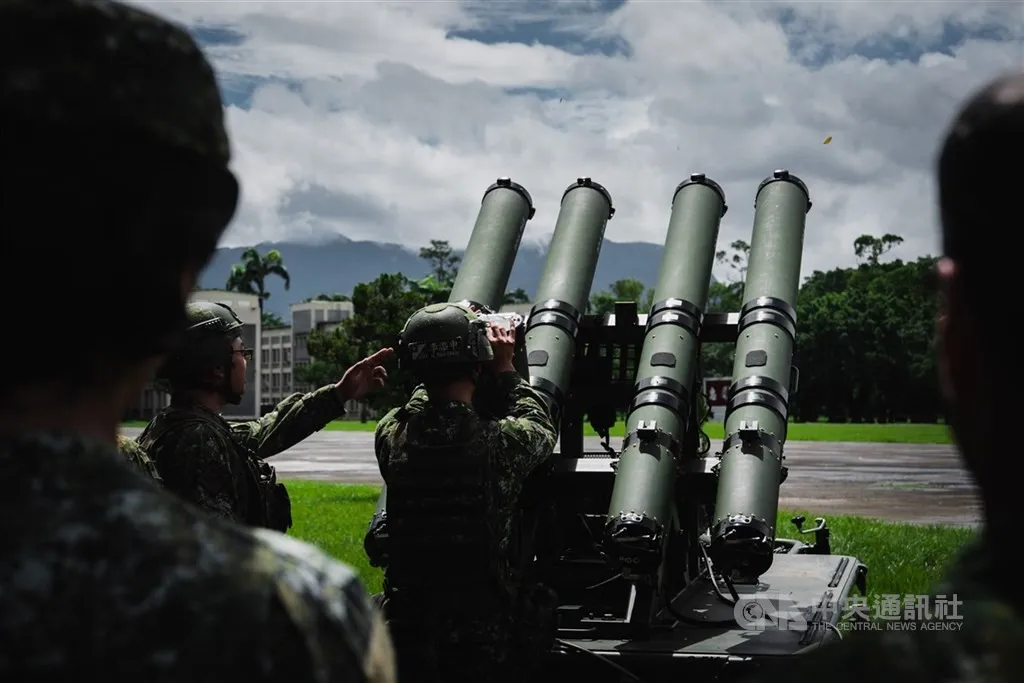
In parallel budget planning reported the same week, the army proposed an NT$11.03 billion restocking of Stinger surface-to-air missiles for existing Avenger, Dual Mount Stinger, and Apache launch platforms. The schedule was shortened from six years ending in 2031 to five years ending in 2030, concentrating most spending between 2028 and 2030 while keeping the overall funding envelope unchanged.
Separately at the same briefing, Navy Command Headquarters Vice Admiral Chu Hui-min said the navy's inventory of RIM-66 Standard Missile-2 interceptors aboard Keelung-class destroyers remains sufficient for wartime requirements. He said carried and stored stocks are adequate, overall condition is normal, and component maintenance channels with the United States remain available even as some missiles approach service-life limits.
Chu also updated the status of the indigenous Hai Kun submarine prototype, saying the boat remains at CSBC Corp facilities for equipment inspection and calibration and will continue sea testing under existing procedures. He declined to set a delivery date and said safety and quality would take priority over any calendar target, while noting that contractual daily penalties for late delivery continue under the navy's contract with the shipyard.
Asked about reports of delays affecting a roughly US$14 billion U.S. arms package, Major General Chiao Fu-chun, a defense ministry deputy spokesman, said Taipei remains in close contact with Washington through established channels. He said ministries have received repeated assurances that U.S. policy toward Taiwan is unchanged under the Taiwan Relations Act and the Six Assurances.
Taken together, the briefing emphasized execution readiness on the domestic unmanned and munitions track while the legislature still holds the supplementary appropriation, and continuity messaging on U.S. security cooperation even as larger foreign military sales cases move through political and industrial bottlenecks.
This report was produced through TaiwanDefence’s automated publishing system and includes links to its supporting sources.
Discussion (0)
Comments are not currently available.