
ANALYSIS
Taiwan's new NT$3.1bn missile upkeep deal shows how much it still leans on ageing air defences
A maintenance contract reported on 20 October 2026 and a life extension for the 20-year-old Antelope show Taiwan paying to bridge the gap until NASAMS arrives.
TAIPEI —
This article is an original Taiwan Defence analysis based on the cited public sources. It distinguishes reported facts from analytical judgments and does not represent original field reporting.
On 20 October 2026, the Liberty Times reported that the Taiwan air force's Air Defense and Missile Command had awarded the National Chung-Shan Institute of Science and Technology a contract worth about NT$3.12 billion to maintain system equipment from August 2027 to June 2034, a span of nearly seven years. The contract was awarded on 7 October and announced on 16 October through a restricted tender in which the institute was the only bidder. It was classed as sensitive national-security procurement, and the work will be done in Qishan district, Kaohsiung. The tender does not name the equipment, but the paper judged from comparisons that it is probably linked to the Tien Kung air defence missiles.
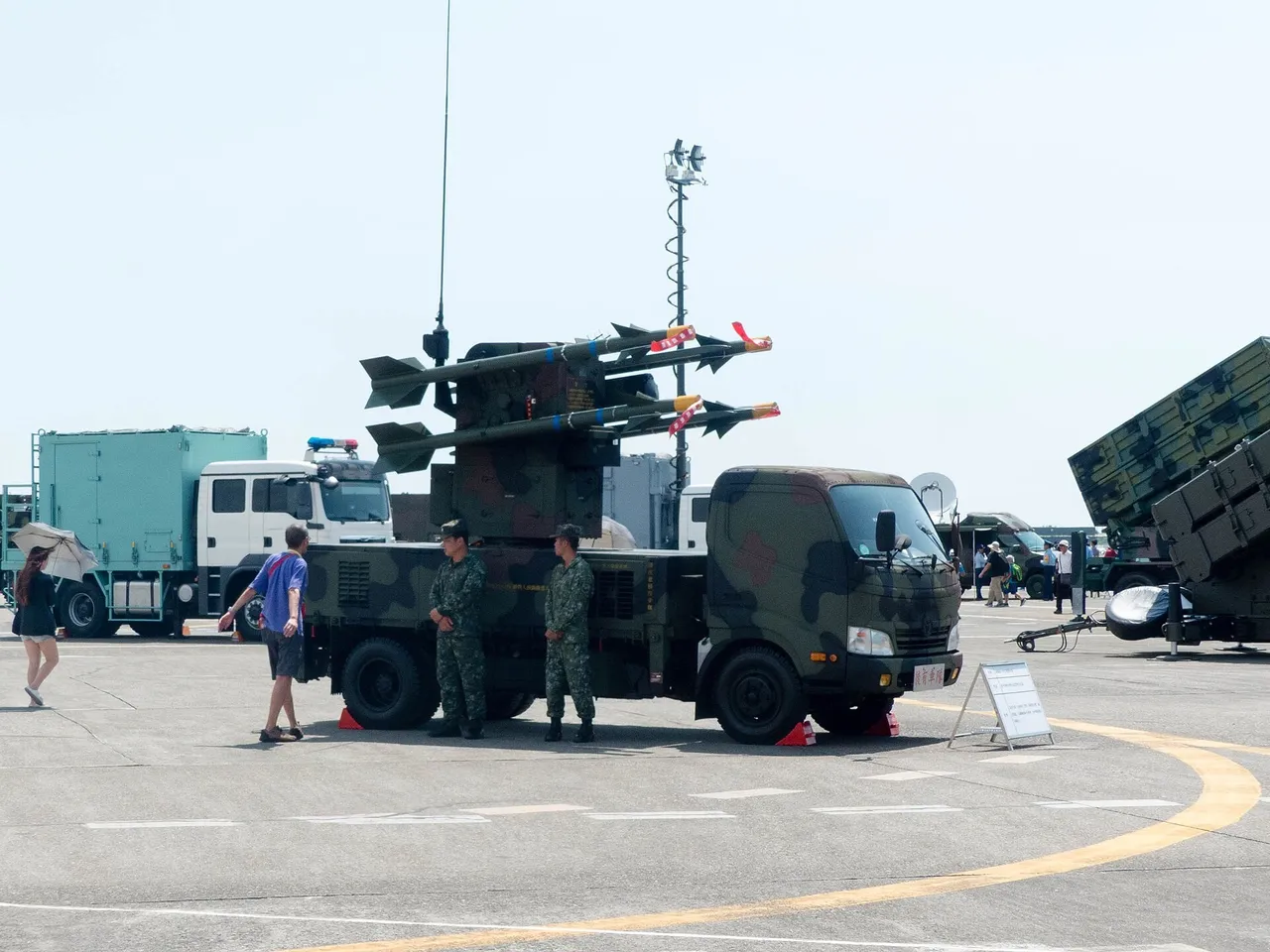
The same day, TVBS reported that the air force's 2027 budget sets aside NT$1.557 billion over five years for the institute to extend the life of its 17 to 20 Antelope short-range air defence systems. The work covers key missile components, vehicle maintenance and the operating software, which TVBS said is rumoured to still run on Windows XP.
The argument
Taken together, the two items point to one conclusion. For the rest of this decade, a large part of Taiwan's ground-based air defence will rest on keeping existing systems ready rather than on new ones. That is less a sign of neglect than a consequence of delivery schedules: the replacements are bought, but they are not yet in place.
Evidence and constraints
The Liberty Times listed other 2027 budget lines that point the same way. An overhaul of Tien Kung launchers, communications and support equipment by the institute is budgeted at about NT$1.56 billion in total, with NT$372 million next year. Follow-on support for the Tien Kung weapon system totals about NT$2.31 billion, and an overhaul of Patriot equipment about NT$1.15 billion. The paper cautioned that the new contract's dates do not exactly match those plans, so it could not confirm that they are the same programme.
The Antelope mounts four locally built Tien Chien I infrared-guided missiles, originally an air-to-air weapon for the Indigenous Defense Fighter, on a commercial truck chassis to protect air bases at low altitude. China Times put its range at about 9 kilometres and TVBS at 8 to 10 kilometres. China Times said the air force began receiving the system in 2000, while the Liberty Times said it formally entered service in 2005. The China Times report said the life-extension money will re-test and replace the missiles' rocket motors, seekers and batteries and repair launch vehicles and short-range search radars worn by salt air, keeping the system in service until at least 2031.
The weaknesses are well documented. Military sources told the Liberty Times in August that the system's radar was adapted from a missile seeker, sees only a short distance and cannot join a networked air defence picture, making small drones hard to track. Each vehicle carries four missiles that crews must reload by hand, and the vehicles have no armour. Chou Yu-ping, a former planning chief at the missile command, told TVBS that an infrared missile may struggle against drones.
The replacement is NASAMS. Taiwan bought three systems first, and the Liberty Times reported that Washington planned to sell nine more for a total of 12. China Times said NASAMS is expected to reach initial capability by the end of 2031, and TVBS said the first batch will be fully delivered before then. Under current plans, the Liberty Times said, the air force will use NASAMS to guard air bases while the army and marines field the locally made Land Sword II for mobile air defence.
What could change
Analysts quoted by TVBS do not see the Antelope simply disappearing. Lu Te-yun, a former defence ministry inspector, called it a low-cost way to defend specific sites and suggested placing it on outlying islands such as Lanyu and Green Island, while Shih Hsiao-wei, an aviation and military website editor, said it could keep a role alongside NASAMS if tasks are divided well.
The main variable is timing. Any slip in NASAMS deliveries would lengthen the period in which systems designed around threats of the 1990s carry the load, and the sustainment budget would have to stretch further. Whether the life-extended Antelope can be linked into a modern air defence network is a technical question that the public record does not yet answer.
Why it matters
Upkeep contracts rarely draw attention, but they show where Taiwan's air defence actually stands today. The October 2026 deals suggest the island is paying a modest price to avoid a gap before NASAMS arrives, while accepting that the bridge has clear limits against the drones and cruise missiles China has been practising with.
Sources
More in Analysis
Taiwan's army is building its tank force around the M1A2T as frozen funds put its upkeep at risk
With Abrams tanks bound for the Lien Yung drill in late 2026 and CM11s headed for storage, a frozen NT$1.3 billion parts budget is the weak link.
TaiwanDefence · 22h ago · 3 min read
US Space Force's counterspace warning shows the satellites a Taiwan fight depends on are now targets
An Oct. 13, 2026 Space Systems Command assessment says China fields weapons that can jam or destroy the satellites US forces would lean on near Taiwan.
TaiwanDefence · 2d ago · 3 min read
US Army's LUCAS mission-kill plan shows cheap drone mass is becoming its way into China's sea defences
Maj. Gen. Bernard Harrington's Oct. 14, 2026 AUSA remarks on blinding warships with low-cost drones echo the swarm logic Taiwan is already betting on.
TaiwanDefence · 2d ago · 3 min read
Discussion (0)
Comments are not currently available.