
US Army sent balloon swarms meant for a Pacific test to Middle East operations instead
The Army scrubbed a plan to fly over 100 high-altitude balloons over Indo-Pacific waters; its space chief now calls them game-changing as China fields its own.
TAIPEI —
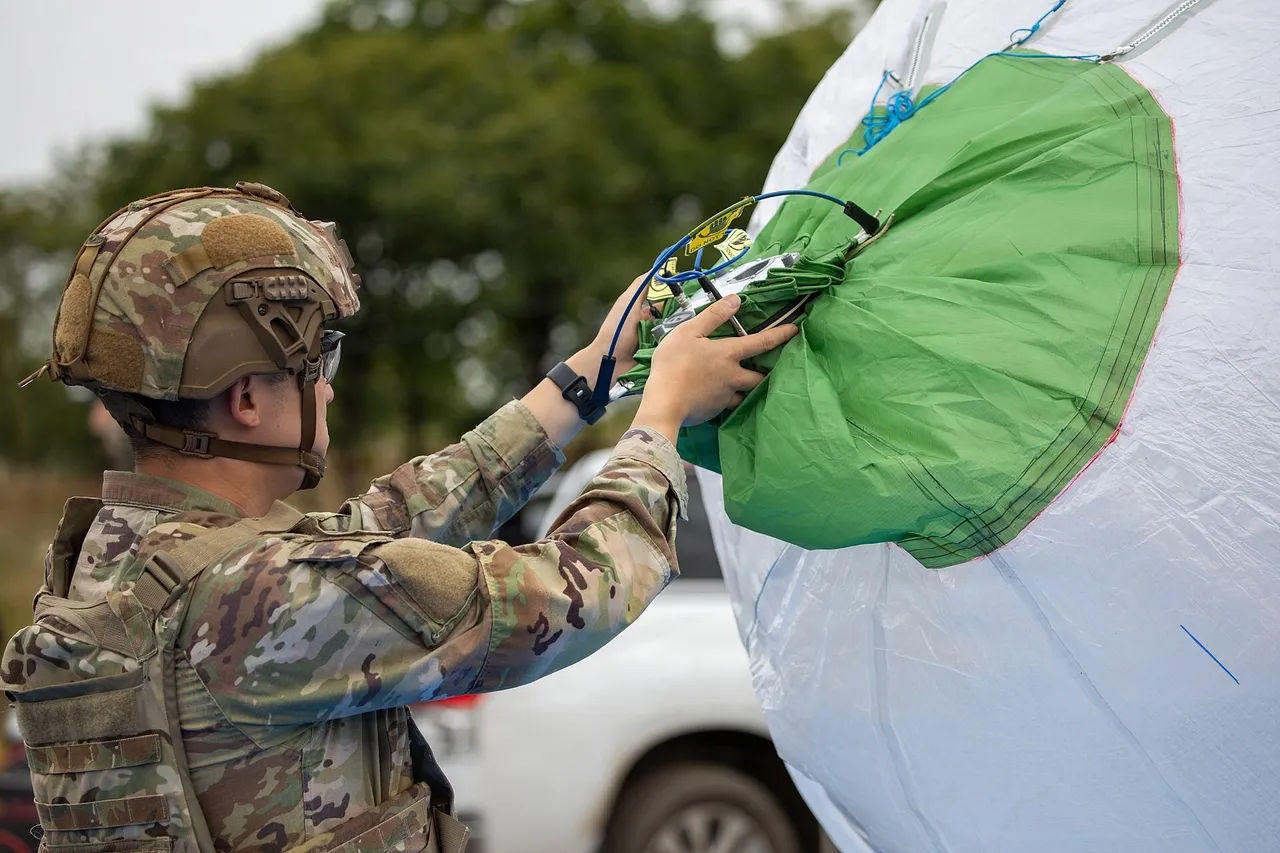
The US Army scrapped a planned demonstration of high-altitude balloon swarms over Indo-Pacific waters and sent the balloons to support real operations in the Middle East instead, Army officials have disclosed on the sidelines of the Association of the US Army (AUSA) annual meeting in Washington this week.
Andrew Evans, director of the Strategy and Transformation Office in the Army's intelligence staff, the G-2, told Breaking Defense on 12 October that the service had been asked to pivot and combine experimentation with operations, and that it ended up supporting US Central Command (CENTCOM). He said the balloons were effective for the mission they were given, but would not say where or how they were used.
The Army had been looking to fly more than a hundred high-altitude balloons over the Indo-Pacific in that demonstration. Testing has usually involved one or two balloons at a time; in the Middle East the Army went from one, to two, to dozens flying at once, Evans said.
Those smaller swarms exposed three problems. Shipping the balloons into the region and storing them was hard, because they are sensitive to temperature and weather. The Army also had to work out what it must own and operate itself and what vendors can supply as a service, and found few people trained to fly the systems. Airspace control, a familiar issue as more drones share the sky with crewed and civilian aircraft, was the third.
On 14 October, Lieutenant General John Rafferty, who heads Army Space and Missile Defense Command (SMDC), told a media roundtable attended by The War Zone that he first thought the idea of using balloons sounded crazy. He said he changed his mind after watching them with the 2nd Multi-Domain Task Force during training in Morocco, where they could hold position, sense and even deliver effects from high altitude, and he now calls them game-changing.
Colonel Joseph Mroszczyk, a former multi-domain task force commander who now leads SMDC's space superiority integration directorate, said his unit had experimented a lot with balloons in the Pacific. He is pushing for a family of stratospheric systems, from small to large, working between about 60,000 and 100,000 feet to provide satellite-like sensing and communications and to release drones, known as launched effects. More experiments on command, control and networking are planned over the coming year.
Modern designs can stay over an area for days, weeks or even months by changing altitude to ride different winds, and from that height their sensors can look across very wide areas while staying in international airspace. Even so, Evans said the Army has not decided whether its stratospheric sensing will come from balloons, solar gliders or some kind of pseudo-satellite.
China already uses balloons widely for intelligence gathering, The War Zone noted, and a Chinese balloon crossed the United States and Canada in 2023. Taiwan has seen them too: its defence ministry reported a record eight Chinese balloons around the island on 9 February 2024, two of which crossed northern Taiwan at altitudes between 4,572 and 11,582 metres.
Sources
More in Indo-Pacific
Chinese navy helicopter shadows Philippine patrol flight over Scarborough Shoal
A PLA Navy helicopter tailed a Philippine AW109 over the disputed shoal on 15 October, as Beijing said its forces warned the aircraft out of its airspace.
TaiwanDefence · 53m ago · 2 min read
US Army runs five new interceptor races, including a Patriot missile under $1m
The Army's fires acquisition chief says buying more PAC-3 MSEs is not enough, so it is opening air-defence missile contests to more and cheaper suppliers.
TaiwanDefence · 4h ago · 2 min read
Japan moves to jail unapproved land buyers near SDF bases exposed to drone attack
A draft bill shown to Japan's ruling party would require state permission for land deals within about 1km of drone-vulnerable military and coast guard sites, with up to three years in prison for violators.
TaiwanDefence · 15h ago · 3 min read
Discussion (0)
Comments are not currently available.