
ANALYSIS
Why Taiwan's coast guard drones, revealed in November 2026, hinge on a OneWeb link rather than Starlink
A 21 November 2026 report says Taiwan's coast guard drones and drone boats send long-range video over OneWeb, because Starlink is still not licensed there.

TAIPEI —
This article is an original Taiwan Defence analysis based on the cited public sources. It distinguishes reported facts from analytical judgments and does not represent original field reporting.
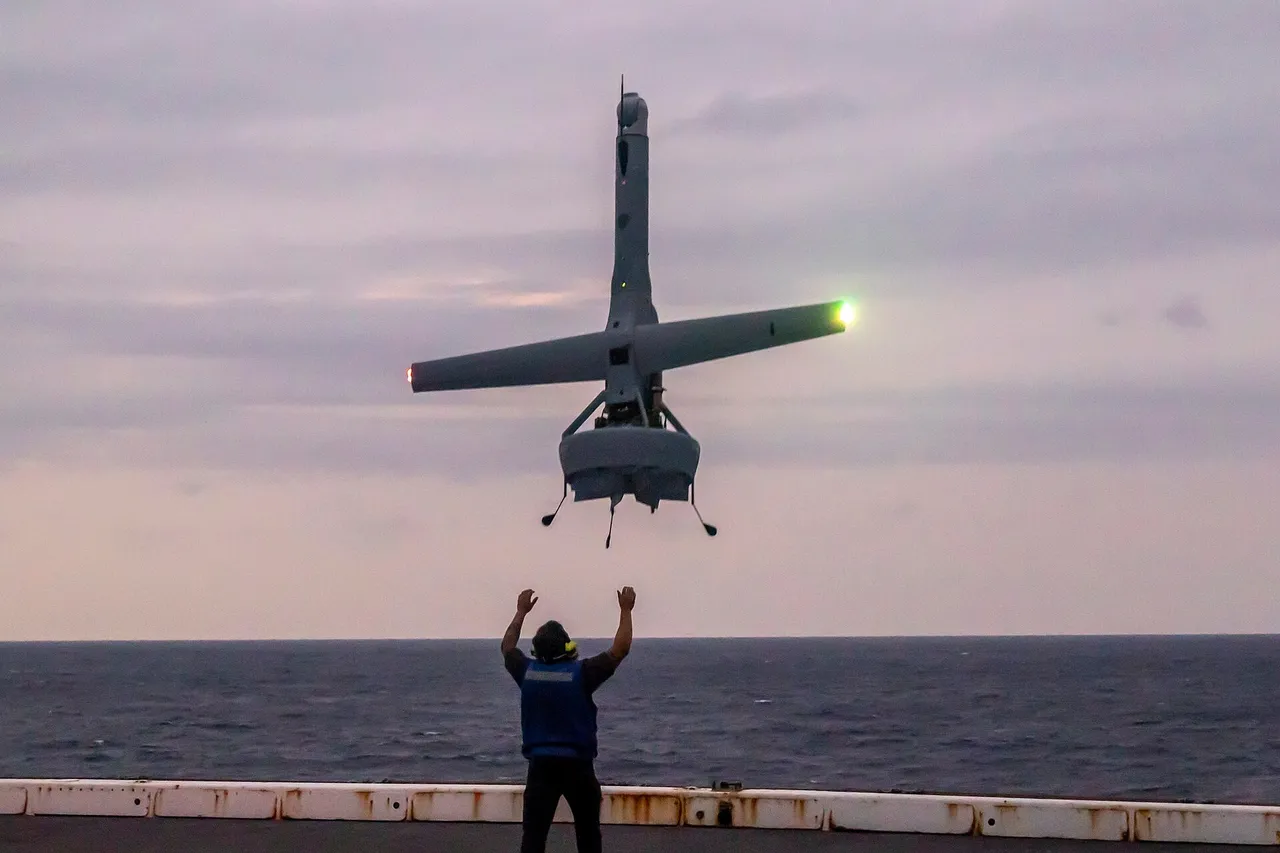
On 21 November 2026, United Daily News reported that Taiwan's Coast Guard Administration has bought 12 V-BAT drones and 17 T-24 uncrewed surface vessels for long-range surveillance, with a reach of more than 100 km, and that their long-range video and positioning data currently travel over radio and the OneWeb low-orbit broadband service offered by Chunghwa Telecom, because Starlink is not operating in Taiwan. Within about 12 nautical miles the craft use existing wifi links. In the days before, the V-BAT, an order won by Aerospace Industrial Development Corporation, had been flying airworthiness tests at Hengchun airport in Pingtung.
Both platforms are able to use Starlink. The paper said the US maker of the T-24, MarTac, had hoped at a demonstration in Taiwan last year to show how it could start a boat in Florida remotely over Starlink. But the service has no licence in Taiwan; a person familiar with the plans told the paper that satellite systems such as Starlink are meant to be added as backups for diversity, yet Starlink is still not authorised. On 9 November officials told lawmakers that Starlink had not resumed talks with the National Communications Commission, even though amendments to the Telecommunications Management Act passed earlier in the year were meant to ease its entry, and the digital affairs minister said the company had been slow to answer the ministry's emails.
The OneWeb route was not improvised. In 2025 the coast guard tendered a low-orbit satellite broadband equipment and service contract budgeted at NT$55.98 million, which Chunghwa Telecom won after becoming, in June 2025, the first Taiwanese operator licensed to sell OneWeb fixed satellite service. CM Media reported at the time that the coast guard was probably the first Taiwanese agency to adopt the European system. According to the 21 November report, the US supplier will also build image-receiving stations at several coastal sites, and the coast guard's main ships and its operations centre in Taipei will be able to receive the feeds.
A link that sets the ceiling
The value of a surveillance drone lies in getting pictures back while they are still useful. United Daily News noted that Taiwan has no sovereign satellite relay of its own yet, although the national space agency is pursuing an experimental low-orbit communications satellite, so whether the new craft can do their job depends on returning imagery in the first minutes. That makes a single commercial constellation a critical dependency. At a 4 November report launch in Tainan by the DSET think tank, Marvin Park of US sea-drone maker Saronic said OneWeb alone was not enough for uncrewed boat missions, and a DSET analyst said OneWeb does not match Starlink on latency, bandwidth or availability.
The speakers in Tainan urged a layered plan of primary, alternate, contingency and emergency links, with radio, mobile networks and even old high-frequency radio as fallbacks, plus onboard computing so that boats can keep working on fragments of data. The coast guard's present mix of OneWeb, radio and short-range wifi is a start on that layering, but each layer has limits. Wifi stops at around 12 nautical miles, line-of-sight radio depends on antenna height, with DSET estimating that a control station about 300 metres above sea level supports roughly 24 nautical miles, and the only satellite path runs through one provider.
The air side brings its own rules. Because the V-BAT did not arrive with a US government airworthiness certificate, as the US-donated JUMP20 drones did, the Civil Aeronautics Administration has to test the aircraft itself, including sampling and dismantling parts, and using its range of more than 100 km requires the coast guard to agree airspace with the air force and civil aviation authorities. Officials said the drones will be based in ports in the north and south of Taiwan and will sail with ships when tasked, while the new ocean patrol vessel Siraya is to serve as the test mothership for drones and drone boats.
Why the navy is watching
The stakes go beyond the coast guard. Taiwan's navy plans to spend NT$35 billion on 280 V-BAT drones and sent observers to the Hengchun tests, so the coast guard's experience with data links is likely to shape a much larger military fleet. If Starlink stays out, Taiwan's drone surveillance will rest on OneWeb and whatever other networks arrive; the digital affairs minister has said Amazon's Leo service could be among the first foreign satellite services deployed in Taiwan.
The test for the coast guard over the coming year is therefore less whether the V-BAT and T-24 perform as advertised than whether shore stations, OneWeb terminals and backup radios can move their video to decision-makers fast enough, including when an opponent jams or overloads the links. Building that network, and securing a second satellite option, is what will turn the purchases into a working surveillance system.
Sources
More in Analysis
Why South Korea's lawmakers used the 16 November 2026 budget review to arm KF-21s and fix Apaches
Seoul's defence committee added about 1.4 trillion won to the 2027 budget on 16 November 2026, favouring KF-21 weapons and Apache upkeep over failing projects.
TaiwanDefence · 5h ago · 4 min read

Why China's armour gathering at Zhuhai in November 2026 is built around the drone war
Unverified images from the Zhuhai show site in November 2026 reveal unmanned combat vehicles, an anti-drone radar truck and a drone-hunting VT-4B tank.
TaiwanDefence · 7h ago · 3 min read
Why China's warplanes nearly vanished around Taiwan in the November 2026 summit week but its warships stayed
Taiwan counted just two Chinese military aircraft on 21 November 2026, down from 32 at the start of the month, yet six to eight warships stayed around the island every day.
TaiwanDefence · 15h ago · 3 min read
Discussion (0)
Comments are not currently available.