
ANALYSIS
Why Taiwan's Huanzhan air-defence network, declared ready in November 2026, is only the start of T-Dome
Taiwan's air force declared its joint air-defence command network combat-ready on 26 November 2026, but the AI layer, new interceptors and base links still lag.

TAIPEI —
This article is an original Taiwan Defence analysis based on the cited public sources. It distinguishes reported facts from analytical judgments and does not represent original field reporting.
On 26 November 2026 Taiwan's air force commander, General Cheng Jung-feng, presided over a ceremony declaring the full Huanzhan system combat-ready, the defence ministry's Youth Daily News reported on 27 November. The paper said the event marked the completion of a system-wide replacement of the air force's air-defence command and control. It said the new setup integrates intelligence and passes command and control, flight-safety, cyber-security and system-integration data in real time, so that commanders can follow activity in the air quickly and fight more jointly.
The milestone matters because Huanzhan is the wiring that Taiwan's planned layered air defence, known as T-Dome, is meant to run on. But finishing the network does not finish the shield. With the backbone declared ready, the limits on how fast Taiwan can sort and destroy incoming missiles and drones now sit in three other places: the decision software meant to run on top of it, the interceptors it is supposed to steer, and the air bases at its edges.
What has been switched on
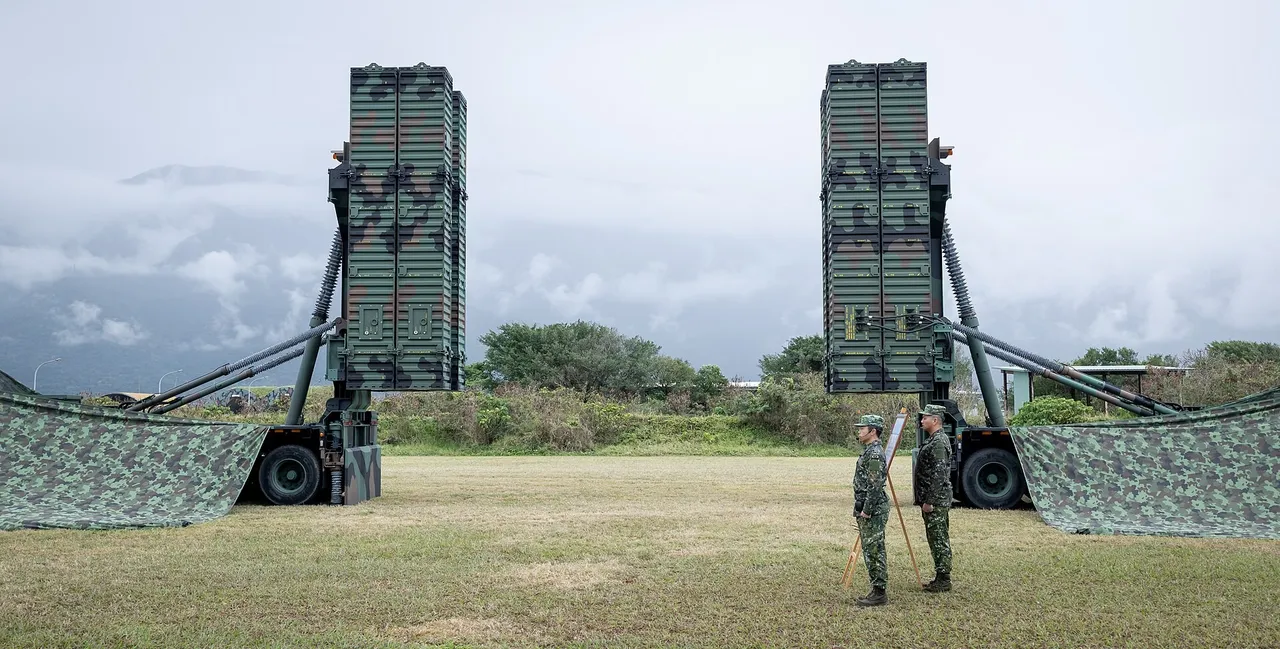
Youth Daily said the ceremony traced the service's air-defence command from hand-plotted tracks through semi-automatic to fully automated systems, and that other units joined by video link. The paper did not list which sensors and weapons are now connected. The Taipei Times reported in June that the project, formally the second-phase Huanwang enhancement programme, was meant to replace separate army, navy and air force air-defence systems with one automated joint network. It was to share radar tracks across command centres and link Patriot, Tien Kung and Tien Chien missiles with the Leshan early-warning radar and E-2K radar aircraft.
It has arrived late. Up Media reported in March 2025 that the work, led by the National Chung-Shan Institute of Science and Technology, had slipped by at least five years and that its cost had climbed from about NT$8.2 billion to more than NT$10 billion. The northern region had been linked by the end of 2024, with the south and east due in 2026. Youth Daily's account of a full-system readiness ceremony indicates that the final stage is now complete.
First bottleneck: the decision layer
The plans described in June included AI-assisted software that would rank aerial threats and recommend which interceptor to fire. That software has only now been paid for. The Liberty Times reported on 21 November that about NT$64.5 billion of the NT$145.7 billion defence top-up the legislature passed in full on 20 November is classified and split between two programmes. Accounts after committee review said one is a Taiwan-US joint development and procurement effort worth about NT$64 billion, and the other an AI-assisted decision system worth a few hundred million New Taiwan dollars, kept secret because it concerns command algorithms and information security.
The network the ministry described is therefore, for now, mainly a faster way to share and display tracks across services. Automatic pairing of weapons with targets, which would let a small crew handle a mass raid of drones and missiles, is a separate step that has only just been funded and whose schedule has not been published. Nothing in the ministry's account says that layer is already running on Huanzhan.
Second bottleneck: the shooters
Strong Bow, a home-built interceptor meant to form the outer layer against tactical ballistic missiles at altitudes of up to 70km, was the other half of the plan. The Taipei Times reported in June that opposition lawmakers had cut its proposed NT$36.1 billion special budget and that the military would seek to restore the money to keep a deployment target of 2027. The Liberty Times said the supplementary budget passed on 20 November includes Strong Bow among its public items, alongside drones and urgently needed munitions.
A command network is only as useful as the weapons it can cue. Until Strong Bow batteries come off the production line, Huanzhan will mostly be steering the Patriot and Tien Kung batteries Taiwan already has, so its practical gain in 2027 lies in faster, better-shared tracking rather than in a new layer of interception.
Third bottleneck: the air bases
The weakest link may be the last mile. The China Times reported on 16 November that the defence ministry's own summary of new investment projects for 2027 admits that operations centres at air force flying bases still pass intelligence and orders mainly by manual plots and voice telephone. The air force has asked for more than NT$2.6 billion to replace those ageing systems with digital command and control, the paper said.
Fighters on alert are part of the air-defence picture, so a national network that updates in seconds loses value if the link to the bases that launch interceptor jets still runs by phone. That project is a new item in the 2027 budget now before the legislature.
What to watch
Three markers will show whether Huanzhan becomes the brain of T-Dome rather than just its wiring: a ministry statement that the AI decision aid is in service on the network, the fielding of the first Strong Bow units, and approval of the base operations-centre money in the 2027 budget. Until then, the 26 November ceremony is best read as the end of a long and overrun integration project and the start of the harder part.
Sources
More in Analysis
Why India's November 2026 MH-60R milestone still leaves its warships short of helicopters
In November 2026 the US finished handing over India's 24 MH-60R helicopters, a year late. The navy's new warships are still arriving faster than helicopters.
TaiwanDefence · 1d ago · 4 min read
Why the Marines' November 2026 push for a longer-range Naval Strike Missile matters around Taiwan
In November 2026 the Marines said they are studying how to double the NSM's 250 km reach. Yonaguni and the Batanes show what that could and could not change.
TaiwanDefence · 1d ago · 4 min read
Why North Korea's big new destroyers, tracked in November 2026, still need Russia and cannot fight alone
Imagery published in November 2026 shows two 5,000-ton destroyers settling in and yards growing, but the ships lack air and submarine cover and lean on Russia.
TaiwanDefence · 3d ago · 4 min read
Discussion (0)
Comments are not currently available.