
ANALYSIS
Matsu's new cable and what Taiwan's communications backups have actually kept running
The Taiwan-Matsu No. 2 cable failed again on 6 October 2026. Three earlier outages show microwave backups kept phones working, but not everything, and repairs take weeks.
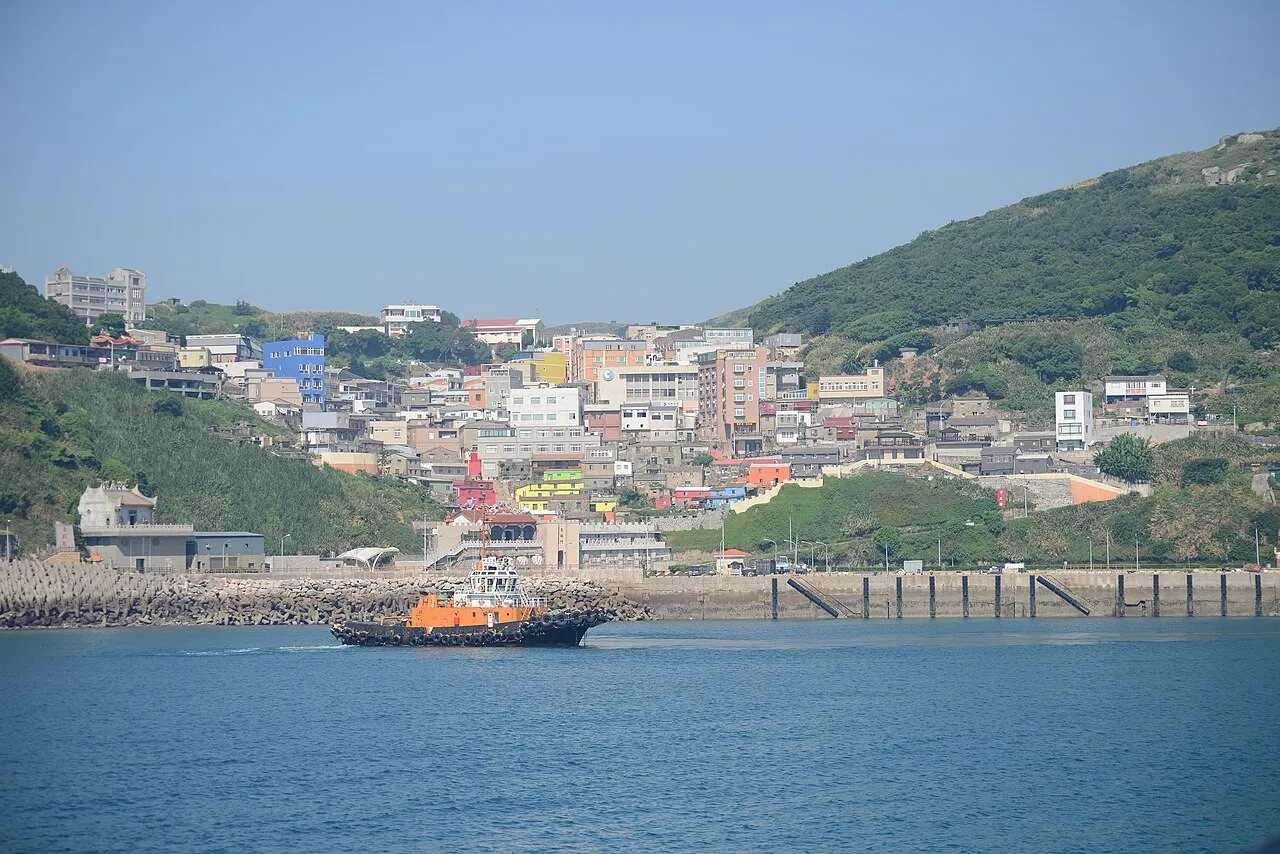
TAIPEI —
This article is an original Taiwan Defence analysis based on the cited public sources. It distinguishes reported facts from analytical judgments and does not represent original field reporting.
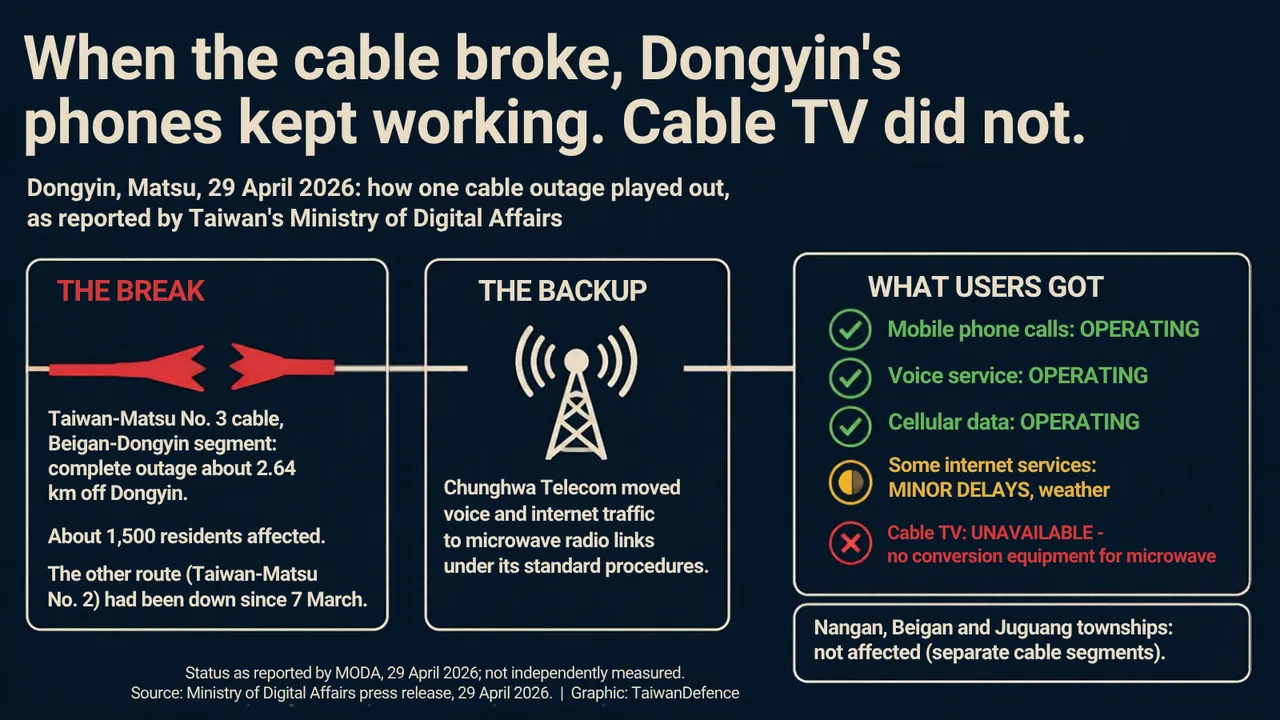
On 6 October 2026, the Taiwan-Matsu No. 2 cable suffered another core-wire fault, and Chunghwa Telecom said traffic moved at once to the No. 3 cable, with no effect on customers. Five months earlier there had been nothing to move to. On 29 April 2026, the Beigan-Dongyin segment of the No. 3 cable, partly damaged about 2.64 kilometres off Dongyin since 30 March, failed completely at the same spot, while No. 2 had been broken since 7 March. For the roughly 1,500 residents of Dongyin, the northernmost township of the Matsu islands, both subsea paths to Taiwan were down.
According to the Ministry of Digital Affairs (MODA), Chunghwa Telecom switched voice and internet traffic to microwave radio links under its standard procedures. Mobile phone calls, voice service and cellular data in Dongyin kept working, though some internet services could see minor delays in bad weather. Cable television did not survive the switch. MODA said it was not supported over microwave because the conversion equipment was unavailable. Nangan, Beigan and Juguang, the other three townships, were on unaffected segments.
That contrast is the useful starting point for judging the newest addition to Matsu's network. On 18 September 2026, MODA and Chunghwa Telecom put the Taiwan-Matsu No. 4 cable into service, so the 6 October fault hit a network with three cables rather than two. The question this analysis tries to answer is narrower than whether Matsu is now resilient. Which services have backup networks demonstrably kept working, what has stayed disrupted, and what does the new cable change?
Sources: moda-tm3-dongyin-2026, moda-tdm2-repair-2026, pts-dongyin-2026
The September cable, and what its headline number means
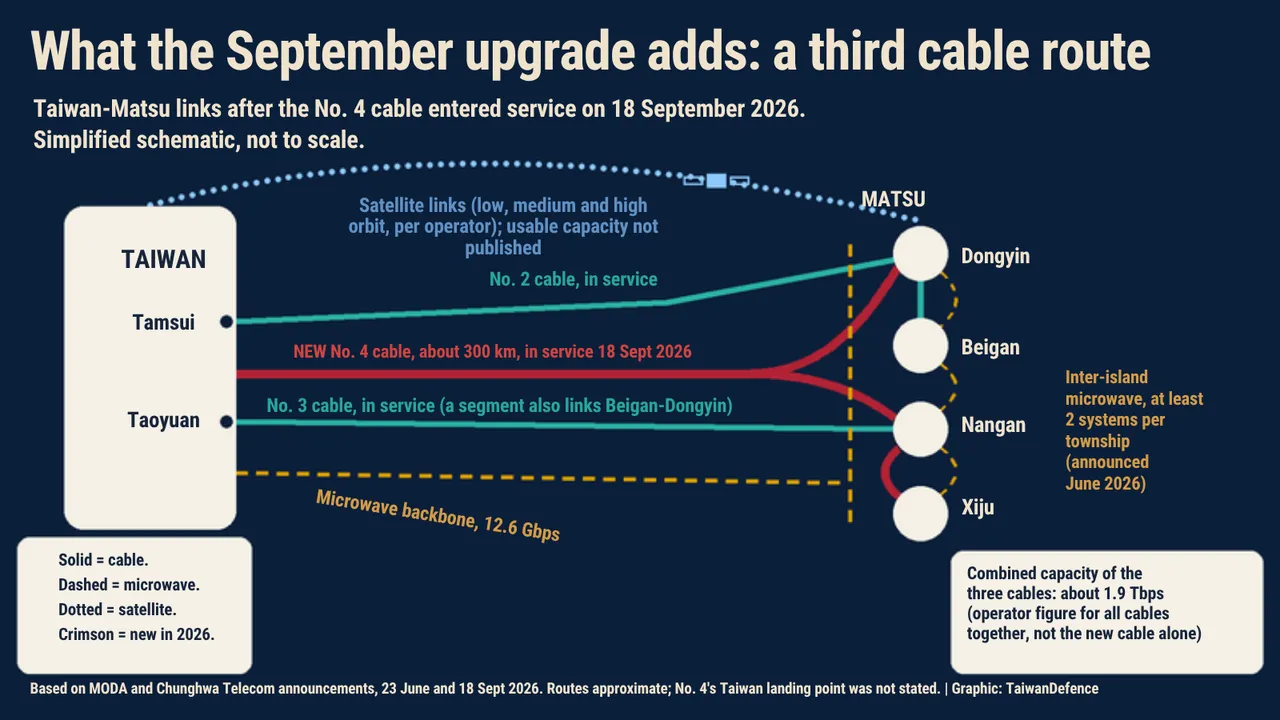
The No. 4 cable runs nearly 300 kilometres from Taiwan's main island to Dongyin, Nangan and Xiju. MODA says it was built by Chunghwa Telecom with subsidies from the Forward-Looking Infrastructure Development Program, uses double-armoured cable, and was laid with a target burial depth of 2.5 metres to reduce the risk from ships and fishing gear. It is also covered by a cable warning system that combines AI recognition with ship-tracking data from the Automatic Identification System (AIS). Chunghwa Telecom puts its own spending at nearly NT$1.4 billion.
The figure that has travelled furthest is 1.9 terabits per second (Tbps). It needs careful reading. Both MODA and Chunghwa Telecom describe it as the overall transmission capacity of the Taiwan-Matsu cables once No. 4 joins Nos. 2 and 3. It is not the capacity of the new cable alone, and it has nothing to do with Taiwan's national international bandwidth. It is also installed capacity: what the systems are built to carry, not traffic that has been measured flowing through them.
The new cable's main contribution is a third route. Chunghwa Telecom says the number of Taiwan-Matsu cables in use rises from two to three, forming three mutually backing routes alongside a 12.6 gigabit-per-second (Gbps) microwave backbone and satellite links in low, medium and high orbits. A microwave link here means radio relay towers on high ground beaming data across the sea, at a tiny fraction of fibre capacity but independent of the seabed. Those are the layers. Whether they work as described can only be judged against what happened when earlier layers failed.
Three outages, one comparison
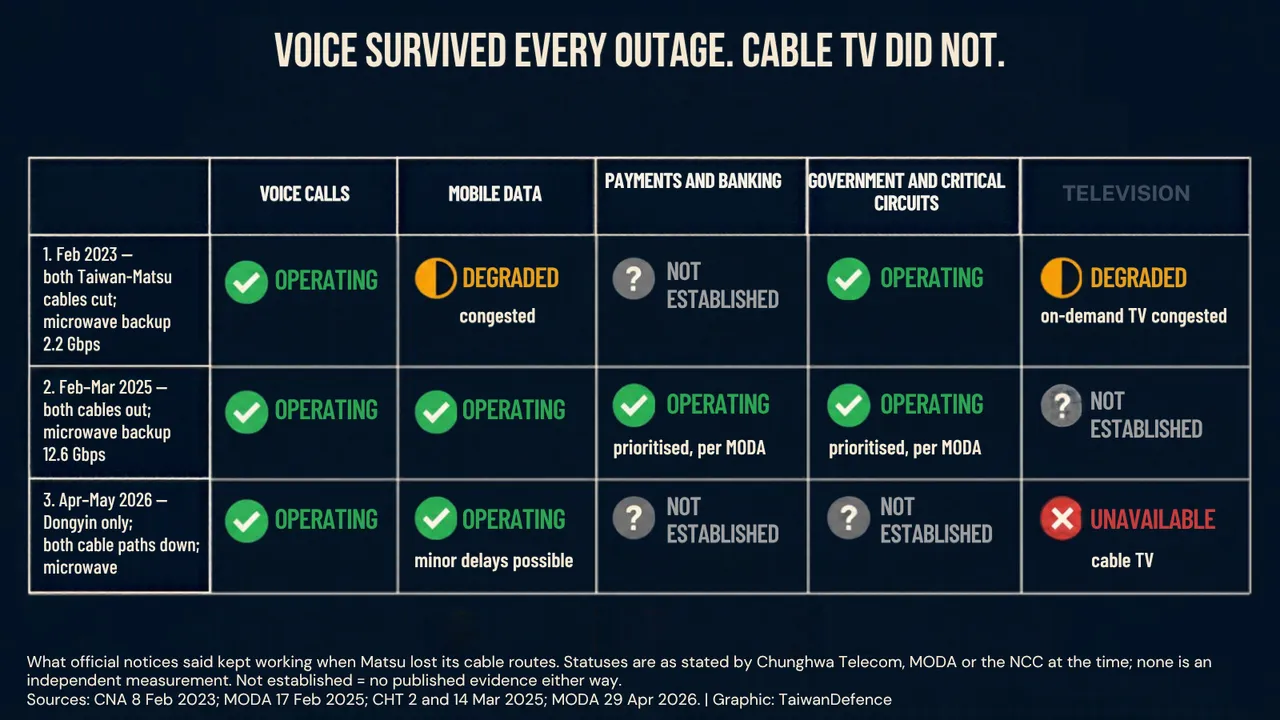
Since 2023, Matsu has lost both of its cable routes at least three times. TaiwanDefence assembled the official notices for each and recorded only what they said about specific services. Where no source said anything, the status is recorded as not established, not as working.
The record mixes four kinds of evidence, and this analysis keeps them apart. Demonstrated performance means a service an official notice said was working during a real outage. Operator and ministry claims cover capacity figures and assurances, such as priority for banks, that nobody outside has measured. Announced projects are things promised but not yet confirmed in service. Conclusions are TaiwanDefence's own reading of the first three, and are labelled as such.
February 2023. On 2 February, the No. 2 cable broke about 52 kilometres from its Dongyin station, and traffic switched to No. 3. On 8 February, No. 3 broke about 40 kilometres from Nangan; Chunghwa Telecom suspected a freighter, while the Open Culture Foundation (OCF) later described both breaks as caused by Chinese fishing vessels. Microwave backup then carried only about 2.2 Gbps. Chunghwa Telecom said voice calls and government, security and livelihood circuits were unaffected, while mobile and broadband internet and its MOD on-demand TV service were congested. Normal service returned on 31 March, when Chunghwa Telecom repaired one of the two cables.
January to March 2025. The No. 3 cable failed completely on 15 January. The No. 2 cable, already partly damaged, failed completely at 12:49 on 16 February off New Taipei City. This time MODA said 12.6 Gbps of microwave capacity was available, more than Matsu's peak daily traffic of 9.5 Gbps, and that priority went to government agencies, banks and hospitals. It said residents could keep using ATMs, credit cards and online banking. Chunghwa Telecom said communications between Taiwan and Matsu were unaffected. Cable repairs were completed on 2 March and 14 March.
April to May 2026. The Dongyin case described above: both cable paths down from 29 April, voice and mobile data running on microwave, cable TV unavailable.
Sources: cna-double-break-2023, cht-microwave-2023, cna-microwave-2023, moda-tdm2-2025, cht-tdm2-repair-2025, moda-tm3-dongyin-2026
Read across the three cases, the result is consistent. Voice and priority circuits were kept running every time. Mobile data moved from congested in 2023 to operating in 2025 and 2026, after the microwave backup grew nearly sixfold. Television is the clearest failure. It was degraded in 2023, not reported in 2025, and unavailable in Dongyin in 2026. The two failures were not the same service. In 2023 the congested service was Chunghwa Telecom's MOD on-demand TV, which the company said in December 2023 could now be carried in full over microwave. In 2026 it was cable television, which MODA said lacked conversion equipment. That makes the 2026 gap a specific equipment problem rather than a capacity limit.
Payments are the weakest part of the record. The only statement on them is MODA's 2025 claim that banking transactions were prioritised and could continue. That is an official assurance, not a measurement, and no comparable statement was published for 2023 or 2026. One more caution belongs here. Every status in this comparison comes from the operator, the ministry or the regulator. None of the sources reviewed published independent speed, latency or failure-rate measurements from inside Matsu during a failover.
Why the backup caught up, and why it is still not a cable
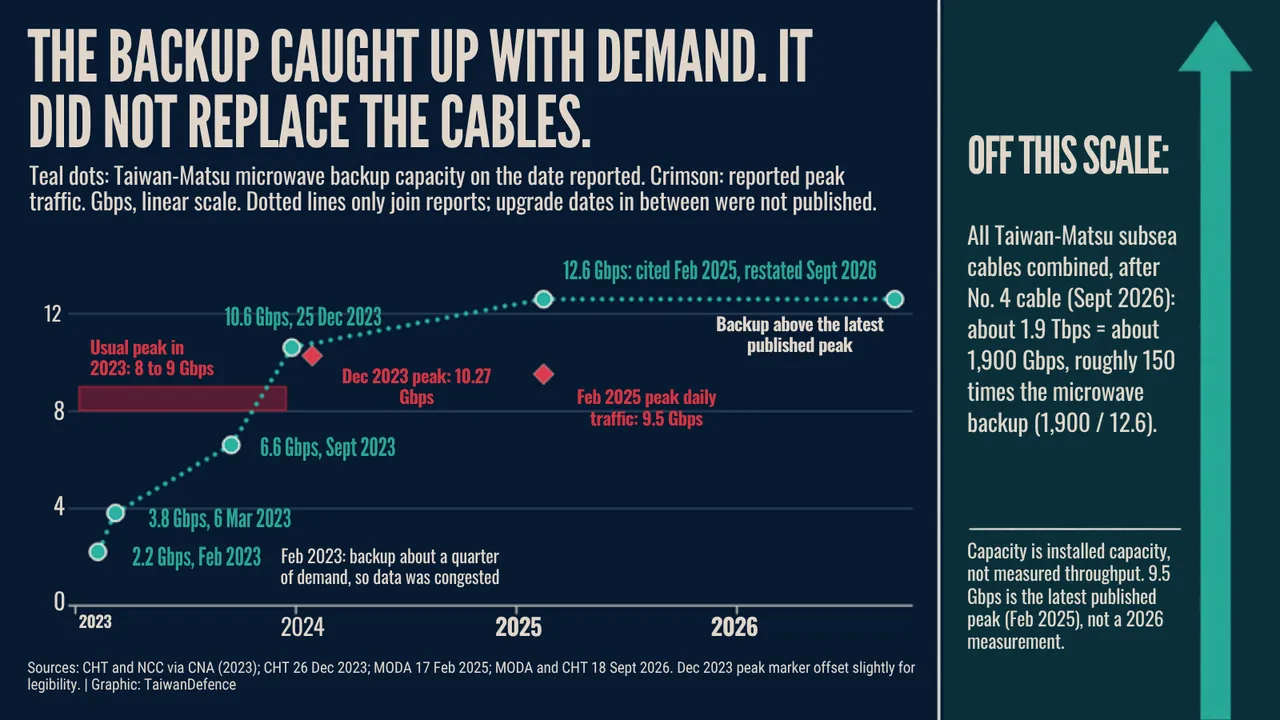
The 2023 outage had a simple cause at the service level. Chunghwa Telecom figures, reported by the Central News Agency (CNA) in October 2023, put Matsu's peak outbound traffic at 8 to 9 Gbps, and the microwave backup could carry 2.2 Gbps, roughly a quarter. The shortfall is arithmetic: 8 to 9 Gbps of demand minus 2.2 Gbps of capacity leaves about 5.8 to 6.8 Gbps with nowhere to go. Chunghwa Telecom kept voice and critical circuits running, but said the backup could not meet residents' demand for internet access.
What followed was a steady build-out. Capacity reached 3.8 Gbps on 6 March 2023, ahead of schedule, which let Chunghwa Telecom resume fixed-line services; Lienchiang County officials said about 70 percent of guesthouse operators could then get online. In October 2023, inspectors from the National Communications Commission (NCC) confirmed that capacity had reached 6.6 Gbps in September. On 26 December 2023, Chunghwa Telecom said it had finished expanding the backup to 10.6 Gbps the day before, across six microwave systems at three stations on each side of the strait, with the longest hop 236 kilometres. It compared that with a then-current peak of 10.27 Gbps and called the result full backup. By February 2025, MODA cited 12.6 Gbps.
Sources: taipeitimes-lienchiang-2023, cna-ncc-microwave-2023, cht-microwave-2023, cna-microwave-2023, moda-tdm2-2025, moda-tm4-2026, cht-tm4-2026
Two cautions keep this from being a simple success story. First, the demand figures are snapshots with different definitions: an 8 to 9 Gbps peak in early 2023, 10.27 Gbps in December 2023, and 9.5 Gbps of peak daily traffic in February 2025. The 9.5 Gbps figure is the latest published, and it is now 20 months old. It is not a measurement of 2026 demand.
Second, the scale gap with the cables is enormous. The 1.9 Tbps of combined cable capacity is about 1,900 Gbps, roughly 150 times the 12.6 Gbps microwave backbone (1,900 divided by 12.6). That does not prove the microwave is insufficient: a link can carry all the traffic people actually generate even if it is far smaller than the cables. But it means the backup is sized for recent demand, not for growth, and has no slack for services, such as cable TV, that were never engineered to run over it.
One outage, two recovery clocks
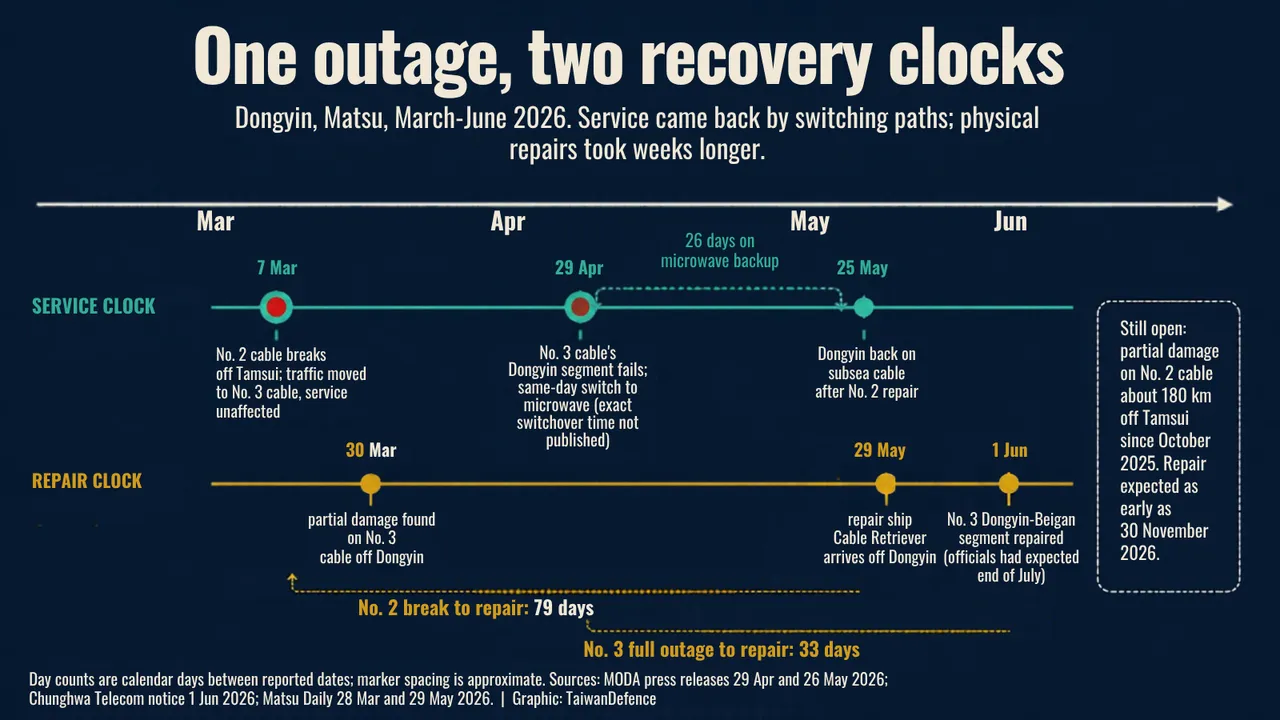
Every Matsu incident runs on two separate clocks. The service clock measures how long users are without a working path. The repair clock measures how long the broken cable stays broken. Official notices often blur them, but they diverge by weeks.
In 2026 the service clock was short because there was something to switch to. When No. 3's Dongyin segment failed on 29 April, with No. 2 already broken since 7 March about 23.6 kilometres off Shalun in Tamsui, Dongyin moved to microwave the same day, though no exact switchover time was published. Dongyin went back onto a subsea cable on the night of 25 May, when No. 2 was repaired. That is 26 days on microwave, counted as calendar days between reported dates.
The repair clock was longer. The No. 2 break took 79 days to fix, from 7 March to 25 May. The No. 3 segment, partially damaged on 30 March and fully out on 29 April, was repaired on 1 June, after the cable ship Cable Retriever reached Dongyin on 29 May. That repair came earlier than the end-of-July estimate MODA had given, which is worth noting. It still took 33 days from the full outage and 63 days from the first damage.
Sources: moda-tm3-dongyin-2026, moda-tdm2-repair-2026, cht-tm3-repair-2026
Repair time is set largely outside Taiwan. As the Institute for Security and Development Policy (ISDP) notes in an August 2026 policy brief, Taiwan has no domestic cable-repair ships, and Chunghwa Telecom relies on membership in international maintenance zones. The Open Culture Foundation cites MODA benchmarks putting average repair time at about 110 days for domestic cables to outlying islands, against about 32 days for international cables, and argues that contingency plans should assume outages lasting months rather than days. Matsu's 2025 and 2026 repairs were faster than the domestic average. They still depended on foreign ships arriving between other jobs and on weather in the Taiwan Strait.
Repair notices also need to be read one segment at a time. The No. 2 cable has a separate partial fault, recorded on 7 October 2025 about 180 kilometres off Shalun, that MODA says still leaves enough capacity for Matsu's peak demand. Its repair is expected as early as 30 November 2026. The 25 May repair fixed the 23.6-kilometre break, not that fault. The local record does not fully match. The Matsu Daily reported in March that earlier No. 2 faults had been fully repaired on 26 February, and its 25 May report describes the final repair work at a point about 40 kilometres east of the Dongyin lighthouse, after the Tamsui-end break was fixed. MODA's notice the next day still lists the 180-kilometre damage as awaiting repair, so this analysis follows the ministry and treats it as open, while noting the conflict.
What the upgrade adds
The No. 4 cable changes the arithmetic of a double failure. Until September, Matsu ran on two cables, and the 2023, 2025 and 2026 outages all happened when both were down at the same time. With three routes, a third fault is needed before traffic must fall back on microwave. The new cable also lands at Dongyin, the township that was cut off in April.
The first test came within three weeks. When No. 2 developed its 6 October fault, Chunghwa Telecom said traffic was rerouted to No. 3 immediately and customer service was unaffected, with repairs under way. That is an operator statement rather than a measurement, and it shows a single failure being absorbed by switching cables, which Matsu could also do before No. 4. What No. 4 adds is a spare route if a second cable fails before the first is fixed.
MODA said in June that each of Beigan, Nangan, Dongyin and Juguang would get at least two microwave systems connecting outward, which would reduce dependence on any single island relay. As of that announcement, these were described as nearly complete; this analysis has not found a later notice confirming they are in service. The same applies further south: MODA said in September that the Taiwan-Penghu No. 4 and Penghu-Kinmen No. 4 cables are expected to be completed by the end of 2026. Until they are in service, they are announced projects, not added resilience.
Sources: moda-tm4-2026, cht-tm4-2026, moda-tdm2-2025
What the cable does not change is just as important. The microwave backbone is still 12.6 Gbps, the figure first cited in February 2025. The services that cannot use microwave, such as Dongyin's cable TV in April, are not fixed by adding fibre. They are fixed by conversion equipment or by keeping a cable alive. The satellite layer has no published usable capacity for residents. A list of orbits or terminal counts says that satellite links exist, not how much traffic they can carry.
What Matsu can and cannot tell Taiwan proper
Matsu is a useful test because it has had complete outages, not just slowdowns, and because officials have documented what happened. Its lessons apply to Taiwan proper in three ways. Backup capacity has to be sized against measured demand, not against the size of the cables it replaces. Services that cannot run over the backup will fail first. And service restoration and physical repair have to be reported separately.
The comparison also has limits. Matsu's peak traffic is around 10 Gbps; OCF puts Taiwan's international bandwidth at about 10.6 Tbps in 2026, three orders of magnitude more. Microwave hops of up to 236 kilometres can carry a small island county but cannot substitute for Taiwan's links to the world. Taiwan proper is served by 14 to 15 international systems, depending on how they are counted, with more cables to fail over to. The Center for a New American Security (CNAS), in its May 2026 report on preventing a communications blackout, concludes that satellites can only supplement Taiwan's cables, given a bandwidth gap of several orders of magnitude.
Existing work already covers several of these issues. OCF's May 2026 study of 2,179 commonly used websites found 39.3 percent relied on foreign-hosted resources and another 49.6 percent on local nodes of multinational clouds, so their behaviour in an international outage is uncertain. That is a dependency Matsu's experience does not test: Matsu's traffic still reached Taiwan and the wider internet through microwave. CNAS counts 28 human-caused cable incidents around Taiwan from 2022 to 2025, three of them suspected or confirmed deliberate. The only court ruling in that set concerns a different route. In June 2025, a Tainan court sentenced the Chinese captain of the Hong Tai 58 to three years for intentionally damaging the Taiwan-Penghu No. 3 cable, a sentence upheld on appeal in August 2025. The Matsu breaks reviewed here have been attributed to vessels, sea conditions, wreckage or ageing, or have no published cause.
The answer so far
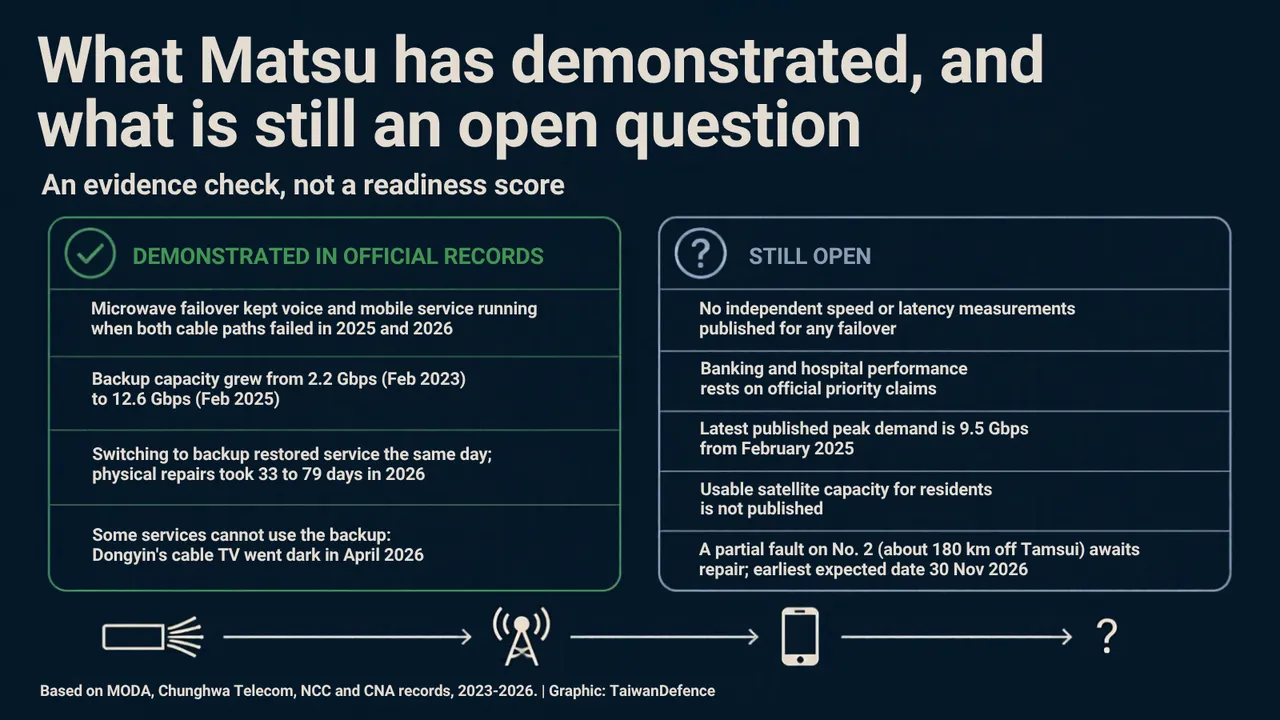
Which services have backup networks demonstrably kept working? On the official record, voice calls and priority government circuits in all three double-cable outages, and mobile data once the microwave backbone was expanded. What has remained disrupted? Cable television, which could not ride the backup in 2026, and in 2023 nearly all data traffic, because the backup was about a quarter of demand. What does the new cable change? It adds a third route and lands at Dongyin, making the double failures that drove all three outages less likely to cut Matsu off from cable, as the 6 October fault suggested. It does not add backup capacity, and it does not repair the segments still waiting for ships.
Sources: moda-tm4-2026, moda-tm3-dongyin-2026, moda-tdm2-2025, moda-tdm2-repair-2026, cht-tm3-repair-2026, cna-microwave-2023, cht-microwave-2023
Settling the rest would take specific evidence. First, independent speed and latency measurements during a failover. Second, current peak demand compared with the 12.6 Gbps microwave figure. Third, performance data from banks and the county hospital during outages, not just assurances of priority. Fourth, published usable capacity for the satellite layer. Fifth, confirmation that the inter-island microwave systems announced in June are in service, and that the 180-kilometre No. 2 fault and the 6 October No. 2 fault are both repaired. Until then, Matsu's backups are best described as proven for calls and basic data, and untested in public for almost everything else.
Sources
- Chunghwa Telecom
- Ministry of Digital Affairs (MODA)
- Chunghwa Telecom
- Ministry of Digital Affairs (MODA)
- PTS News
- Ministry of Digital Affairs (MODA)
- iThome
- Chunghwa Telecom
- Matsu Daily
- Matsu Daily
- Matsu Daily
- Matsu Daily
- Ministry of Digital Affairs (MODA)
- Ministry of Digital Affairs (MODA)
- Chunghwa Telecom
- Chunghwa Telecom
- Central News Agency (CNA)
- Taipei Times
- Taipei Times
- Central News Agency (CNA)
- Central News Agency (CNA)
- Chunghwa Telecom
- Central News Agency (CNA)
- Open Culture Foundation (OCF)
- Center for a New American Security (CNAS)
- Institute for Security and Development Policy (ISDP)
- Reuters
- Central News Agency (CNA)
More in Analysis
Taiwan's new defence committee leaders set up a session-long fight over drones, manpower and delays
In convener elections on 8 October 2026, the DPP drew the defence ministry's agenda while the KMT's Hsu Chiao-hsin put manpower and arms delays first.
TaiwanDefence · 11h ago · 3 min read

Taiwan's new F-16s face a maintenance bottleneck as deliveries finally begin
A legislative budget review reported on 7 October 2026 found Taiwan's F-16 repair centre holds only a third of its planned licensed capacity as new jets arrive.
TaiwanDefence · 12h ago · 4 min read

Outnumbered at sea, Taiwan's navy bets on coastal missiles and submarines rather than hulls
Taiwan's first 128 land-based Harpoons are due by year-end, a senior military source said on 7 October 2026. The buy shows how Taipei is answering a fleet gap it cannot close.
TaiwanDefence · 18h ago · 5 min read
Discussion (0)
Comments are not currently available.