
ANALYSIS
Why the Liaoning's November 2026 Pacific stint rests on oilers that must run Japan's watched straits
An 18 November 2026 tally of eight Chinese supply-ship crossings near Japan shows how the Liaoning stayed at sea, and where that lifeline is exposed.

TAIPEI —
This article is an original Taiwan Defence analysis based on the cited public sources. It distinguishes reported facts from analytical judgments and does not represent original field reporting.
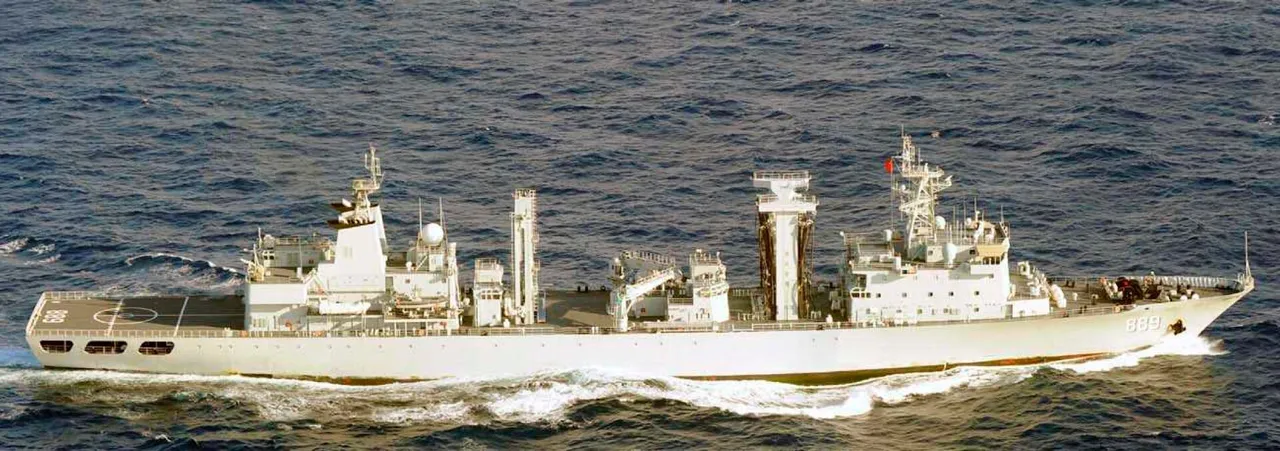
On 18 November 2026 the South China Morning Post, counting Japanese defence ministry statements, found that Chinese replenishment ships had made at least eight passages through the Miyako and Osumi straits since 16 October while the carrier Liaoning stayed out in the western Pacific. The 50,000-ton fast combat support ship Hulunhu accounted for four of them, and three smaller 23,000-ton Type 903A supply ships, Taihu, Chaohu and Kekexilihu, made the other four between them. The paper said the cruise could test the carrier's 40-day record for a Pacific deployment, set in June.
The carrier group itself sailed without a tanker. Japan's Joint Staff Office first detected the Liaoning on 13 October with the Type 055 cruisers Anshan and Wuxi and the Type 052D destroyer Huainan, and the four ships passed between Okinawa and Miyako Island the next day. China's navy announced that the carrier was on routine training. Beijing also said the deployment was not aimed at any country. According to the Asia Society's Center for China Analysis, the group then entered the South China Sea through the Luzon Strait, transited the Basilan Strait in late October and was placed east of the Philippines on 28 October and northeast of Luzon by 4 November. USNI News said on 20 November that the group was still assessed to be in the Philippine Sea, although it had last been sighted in October.
The oilers instead came and went in escorted pairs. Japanese tracking compiled by the Center for China Analysis shows the destroyer Qiqihar taking Hulunhu east through the Osumi Strait on 17 October and bringing it back west through the Okinawa-Miyako gap on 1 November, the cruiser Lhasa escorting Kekexilihu into the Pacific on 27 October, and Qiqihar taking Chaohu out on 2 November before returning alone two days later. Japan's Joint Staff Office reported that on 16 November Qiqihar and Chaohu were sailing north about 60 km west of Kume Island, after the destroyer had crossed the Miyako gap yet again on 12 November, and that a P-3C patrol plane from Naha shadowed them.
A shuttle, not a convoy
The pattern points to a shuttle. Rather than tying a scarce fast combat support ship to the carrier for the whole cruise, the navy appears to have used Qiqihar as a repeat escort, crossing Japan's southwestern straits at least five times between 17 October and 12 November by the Joint Staff Office's count, while rotating supply ships out to the Pacific and home again. Chaohu spent about two weeks east of the island chain before heading back. Such a rhythm would let the carrier's escorts stay on station while supply ships return to Chinese ports to reload.
The Hulunhu is the key ship. The Post noted that the Type 901 can pass fuel, fresh water, ammunition and dry stores at the same time, alongside, astern or by helicopter, and that carrier groups need large amounts of aviation fuel to keep aircraft flying. The Center for China Analysis cautioned that public reporting does not prove the supply ships met the Liaoning rather than working on their own. Even so, four crossings by the navy's largest support ship during a carrier cruise of record length suggest a supporting role.
Every refill passes a Japanese checkpoint
The weakness is geographic. The Center for China Analysis argued that a navy seeking to keep US and allied forces out of waters east of Taiwan needs three things: to move warships through the passages of the first island chain, to keep them at sea for long periods, and to resupply them through chokepoints that Japan and the Philippines can monitor and could target in wartime. It judged that the latest deployment tested all three. The Japanese releases show how exposed the third task is: each oiler run was photographed, identified by hull number and published by Tokyo, and USNI News relayed the 16 November sighting to a wider audience four days later.
That matters more because China's other carriers were close to home. The Post reported that satellite images showed the newer carrier Fujian back at its Yulin base on Hainan after exercises in the South China Sea, while the Shandong has been under repair there since January. If the Liaoning is the carrier China sends east of the island chain, its staying power rests on supply ships getting past Japanese surveillance, not on its own fuel tanks.
What to watch
The next marker is how the Liaoning comes home. Counting from its 14 October transit, the carrier would pass 40 days beyond the island chain around 23 November if it is still at sea, as USNI News assessed. Japanese releases will show whether it returns through the Miyako or Osumi straits with a supply ship or alone after weeks of separate oiler runs. Either way, the autumn of 2026 has shown that China now runs its carrier logistics through straits that Tokyo watches daily, a routine that would be far harder to keep up in a conflict.
Sources
More in Analysis
Why the Philippines' November 2026 talks on Indian missiles hinge on how Manila pays
Reports from 18 to 22 November 2026 say Manila wants more BrahMos, Akash and Pinaka, but India's 15% advance and borrowing limits stand in the way.
TaiwanDefence · 1h ago · 4 min read
Why Taiwan's coast guard drones, revealed in November 2026, hinge on a OneWeb link rather than Starlink
A 21 November 2026 report says Taiwan's coast guard drones and drone boats send long-range video over OneWeb, because Starlink is still not licensed there.
TaiwanDefence · 21h ago · 4 min read
Why South Korea's lawmakers used the 16 November 2026 budget review to arm KF-21s and fix Apaches
Seoul's defence committee added about 1.4 trillion won to the 2027 budget on 16 November 2026, favouring KF-21 weapons and Apache upkeep over failing projects.
TaiwanDefence · 23h ago · 4 min read
Discussion (0)
Comments are not currently available.