
ANALYSIS
Why China's fourth carrier, seen taking shape in November 2026, is about endurance more than the strait
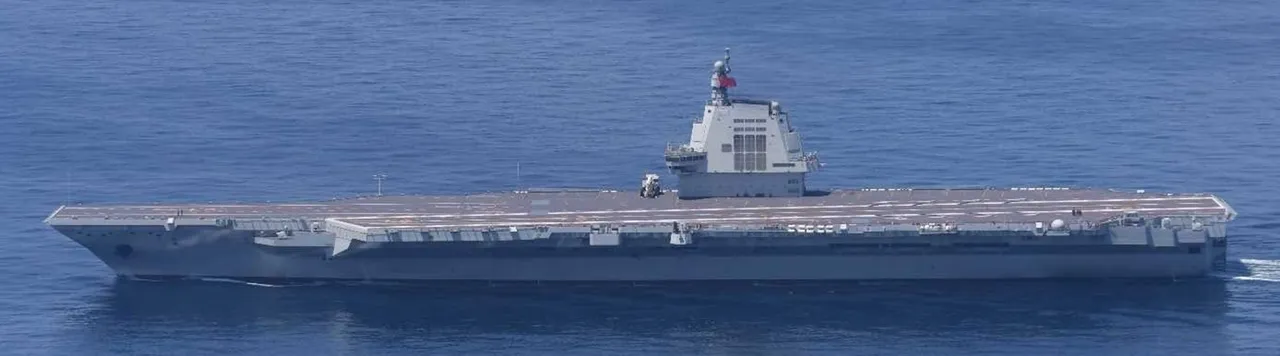
Imagery from 12 November 2026 shows the Type 004 hull filling out at Dalian. Nuclear power would let China keep a big carrier at sea far from its coast.

TAIPEI —
This article is an original Taiwan Defence analysis based on the cited public sources. It distinguishes reported facts from analytical judgments and does not represent original field reporting.
Satellite pictures taken on 12 November 2026 show China's fourth aircraft carrier still advancing quickly in a dry dock at the Dalian shipyard in north-east China, The Aviationist reported on 16 November. The images show new sections along both sides of the hull and more of the flight deck and bow, giving the ship a clearer carrier outline. Defense News, in a report filed from New Taipei City on 23 November, said analysts expect the vessel, known so far only as the Type 004, to be launched as early as 2027.
Most attention goes to the ship's size. For Taiwan, the more important point is endurance. A nuclear-powered carrier could stay far from Chinese ports for long periods without the tankers that the PLA Navy's current carriers rely on. That would turn short carrier visits east of Taiwan into a presence that lasts. Yet the ship is still a hull in a dry dock. Its weight in any crisis depends on years of trials and air-wing training that have not yet begun.
What the imagery shows
The Center for Strategic and International Studies measured the hull at about 322 metres from the unfinished bow to the stern in October 2026, with a beam of about 46 metres, and called the design far larger than any other Chinese surface combatant, according to Defense News. Collin Koh of Nanyang Technological University told the outlet the specifications would make the ship slightly larger than the Fujian, now China's biggest carrier, and that the basic hull form already built points toward a 2027 launch.
The Aviationist said CSIS has identified the new side extensions as preparations for the carrier's weapon sponsons and for its starboard superstructure. It added that CSIS compares the October construction stage with that of the Fujian in May 2021, about a year before that ship was launched. CSIS cautions that the larger size and possibly more complex design could change the timeline. China has not confirmed the ship's name, size or schedule, so these figures remain estimates drawn from imagery.
Why propulsion is the real story
Nuclear power has not been officially confirmed either. The Aviationist reported that CSIS, in its October assessment, judged nuclear propulsion likely because of two compartments of about 15 by 15 metres inside the hull that look consistent with shielded reactor spaces and were not seen on the Fujian. David Silbey, a Cornell University military historian, told Defense News that nuclear power would give the carrier essentially unlimited endurance and allow global deployment without the tanker support a conventional carrier needs.
Defense News also quoted Alexander Huang of the Council of Strategic and Wargaming Studies in Taipei as saying the fourth carrier may be based in northern China because the other three operate from the south. With four carriers, he said, China could keep one operating somewhere at all times. The Asia programme director at the think tank Defense Priorities has estimated an air wing of 75 to 90 aircraft, Defense News reported, against the roughly 50 that earlier Chinese carriers could carry, according to Silbey.
Put together, these points describe a different kind of pressure on Taiwan. A carrier that does not need to refuel and that works from a northern home port could stay in the Philippine Sea or off Japan's southern islands for long stretches. It would cover the eastern approaches that US and Japanese forces would use to reach Taiwan. That is a counter-intervention role more than a strait-crossing one, and it would make the east coast of Taiwan a more crowded place in peacetime.
The long road from hull to capability
The same sources stress how far the ship is from service. Koh told Defense News that deployment would take five to 10 years after launch. CSIS says that after leaving the dry dock the vessel will still need extensive fitting out and sea trials before it is commissioned. The Aviationist noted that the US carrier Gerald R. Ford was launched in November 2013, commissioned in July 2017 and did not begin its first deployment until October 2022.
The air wing is a second limit. The Aviationist expects the Type 004 to fly an air wing similar to the Fujian's, with J-35 stealth fighters, catapult-launched J-15T fighters, J-15DT electronic-warfare jets and KJ-600 early-warning aircraft. Koh told Defense News that a Chinese navy with nuclear-powered carriers could still challenge the United States even with a smaller fleet.
For Taiwan, the launch expected as early as 2027 is a signal to watch rather than a change in the present balance. The useful markers are the reactor question, the choice of home port and the first long patrol beyond the first island chain. Until then the Type 004 mainly shapes planning in Tokyo and Washington. Both face a future in which a Chinese carrier no longer has to head home when the oilers run low.
Sources
More in Analysis
Why China's third new nuclear submarine, seen in November 2026, is aimed at Taiwan's helpers
Satellite images from 6 November 2026 show a third Type 095 boat at Huludao; its range and missiles point at US forces sailing to Taiwan's aid.
TaiwanDefence · 1d ago · 3 min read
Why the Philippines' November 2026 talks on Indian missiles hinge on how Manila pays
Reports from 18 to 22 November 2026 say Manila wants more BrahMos, Akash and Pinaka, but India's 15% advance and borrowing limits stand in the way.
TaiwanDefence · 1d ago · 4 min read
Why the Liaoning's November 2026 Pacific stint rests on oilers that must run Japan's watched straits
An 18 November 2026 tally of eight Chinese supply-ship crossings near Japan shows how the Liaoning stayed at sea, and where that lifeline is exposed.
TaiwanDefence · 1d ago · 4 min read
Discussion (0)
Comments are not currently available.