
ANALYSIS
Why Taiwan's November 2026 push for its own satellite launches matters for wartime resilience
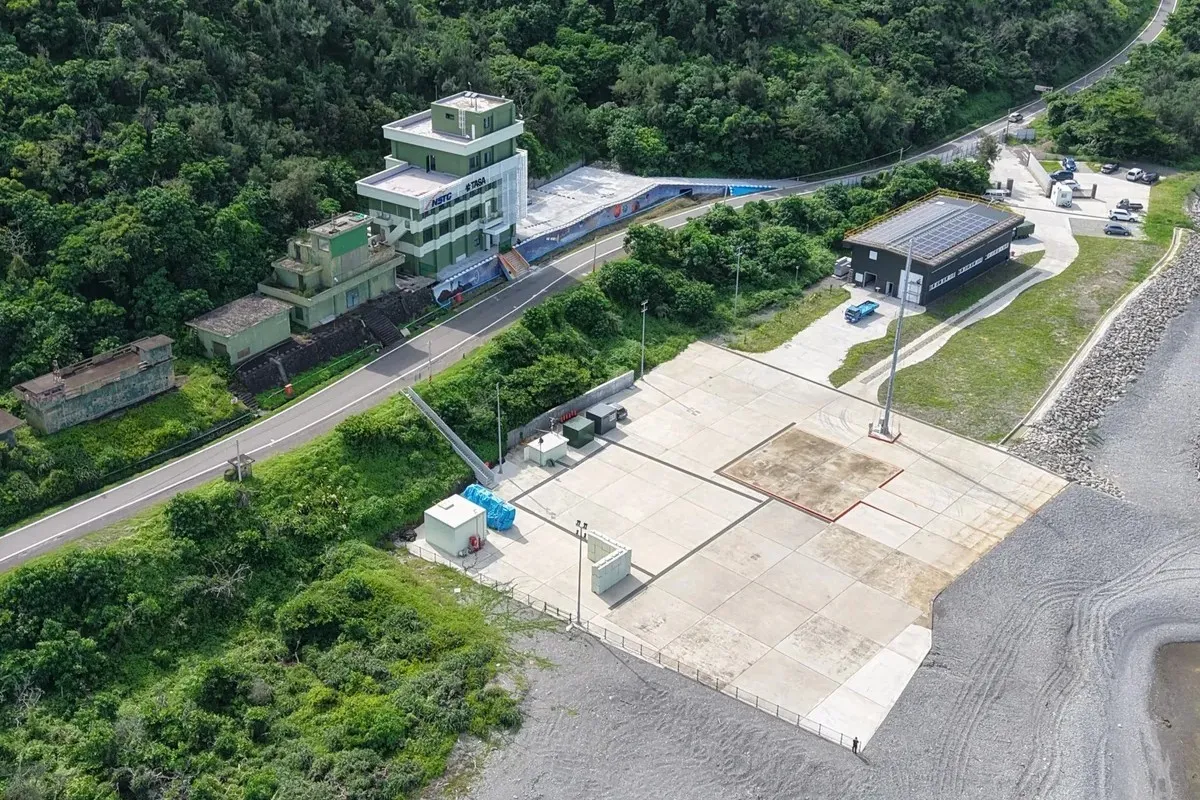
Lai's 9 November 2026 space speech put satellite links and launch access under the security council, but Taiwan's own launch range is not due until 2032.
TAIPEI —
This article is an original Taiwan Defence analysis based on the cited public sources. It distinguishes reported facts from analytical judgments and does not represent original field reporting.
On 9 November 2026, President Lai Ching-te told the opening of the Taiwan International Assembly of Space Science, Technology and Industry, known as TASTI 2026, in Tainan that Taiwan is moving steadily toward launching its own domestically built satellites. According to the Presidential Office, he said the government has approved a rocket research, assembly and testing base at Shalun in Tainan and has chosen Jiupeng in Pingtung County as the site of a national rocket launch range. Focus Taiwan reported that the Taiwan Space Agency's earlier timetable puts the Shalun base into operation in 2030 and the Jiupeng range in 2032.
Lai said the third phase of the National Space Technology Long-term Development Program now has NT$71 billion and runs until 2031. He also said he had set up a space and technology development committee inside the National Security Council to coordinate ministries and draft a national space strategy, and that every government investment in space should ultimately become strength for protecting the country. The Liberty Times reported that he linked satellite applications to national security, disaster response and social resilience.
The argument
The 9 November speech is best read as a resilience argument rather than a prestige project. The capability Lai singled out, satellite communications that keep essential links open when ground networks are damaged, is the service an island under blockade or bombardment would need most. It is also the service most exposed to the fact that Taiwan cannot yet put anything into orbit by itself. Placing a space committee inside the National Security Council signals that the government treats launch access and satellite services as security assets, not only as industrial policy.
Evidence and constraints
Taiwan currently relies on foreign launch providers such as SpaceX, Focus Taiwan noted, and its existing site at Xuhai in Pingtung is used for sounding rockets for research and testing rather than for orbital launches. The private sector shows the same dependence. The United Daily News reported that Foxconn's second-generation PEARL-1A and PEARL-1B low-orbit satellites, shown as models at TASTI 2026, reached an orbit of about 600 kilometres on a SpaceX Falcon 9 on 3 May 2026 and are testing a Ka-band link between the two satellites as well as broadband links to the ground.
Foxconn also displayed modems for 5G non-terrestrial network terminals built on MediaTek chips, phased-array antenna modules and radio frequency converters, according to the same report. The Liberty Times said the Taiwan Space Agency exhibited full-size models of five recent satellite programmes and a model of an orbital launch vehicle, and that the event drew participants from 32 countries.
Taiwan is also widening its partnerships. The China Times reported that National Science and Technology Council head Wu Cheng-wen announced that the Taiwan Space Agency would take part in NASA's Artemis programme to return astronauts to the Moon, and that the aim is to move Taiwanese firms from supplying components toward system design and integration. Focus Taiwan said Wu did not specify the nature of that involvement.
These facts cut both ways. The hardware and supply-chain base is real, and in-orbit testing of links between satellites and of satellite-capable phone modems is relevant to keeping a dispersed government and military connected. But the launch range is six years away on the official timetable, the money is spread across science, industry and infrastructure, and nothing announced on 9 November gives Taiwan an independent way to replace lost satellites during a crisis before the 2030s.
What could change
The national space strategy that the new security council committee is drafting is the next marker to watch. If it sets defence requirements such as responsive launch, protected communications or rapid replacement of small satellites, the programme would become a clearer part of Taiwan's defence planning. Wider cooperation with the United States through Artemis, and with the United Kingdom and France, where the China Times said the space agency has deepened exchanges, could also open launch or hosting options that do not rest on a single commercial provider.
Why it matters
For Taiwan, the value of space power lies less in national firsts than in whether the island can still see, communicate and coordinate if ground networks are damaged or cut off. Lai's 9 November 2026 remarks put that logic at the centre of government policy, but the timetable shows the gap. For at least the rest of this decade, Taiwanese satellites will keep reaching orbit on other countries' rockets, which makes allied and commercial launch access a defence question as much as an industrial one.
Sources
More in Analysis
Why the November 2026 F-16 weapons report matters more for Taiwan than the new jets' arrival
A defence ministry report covered on 9 November 2026 shows Taiwan's new F-16s will fly for years before their glide bombs and jamming pods are complete.
TaiwanDefence · 17h ago · 4 min read

Why the Fujian carrier's 5 November first anniversary matters more for Taiwan than China's combat claims
China marked the Fujian carrier's first year in service on 5 November 2026; its repeated passages around Taiwan matter more than claims of full combat power.
TaiwanDefence · 21h ago · 4 min read
Why China's 5 November TB-001 drone flight past Okinawa matters for Taiwan's eastern flank
China flew an attack-capable TB-001 drone toward Japan's Danjo Islands on 5 November 2026, one of several recent drone loops that also skirt Taiwan's east side.
TaiwanDefence · 22h ago · 3 min read
Discussion (0)
Comments are not currently available.