
ANALYSIS
Why the DF-61 ICBM's move into routine drills in November 2026 matters for a Taiwan crisis
China said on 5 November 2026 that its DF-61 ICBM has entered routine training; analysts doubt that proves faster development, but its survivability matters for Taiwan.
TAIPEI —
This article is an original Taiwan Defence analysis based on the cited public sources. It distinguishes reported facts from analytical judgments and does not represent original field reporting.
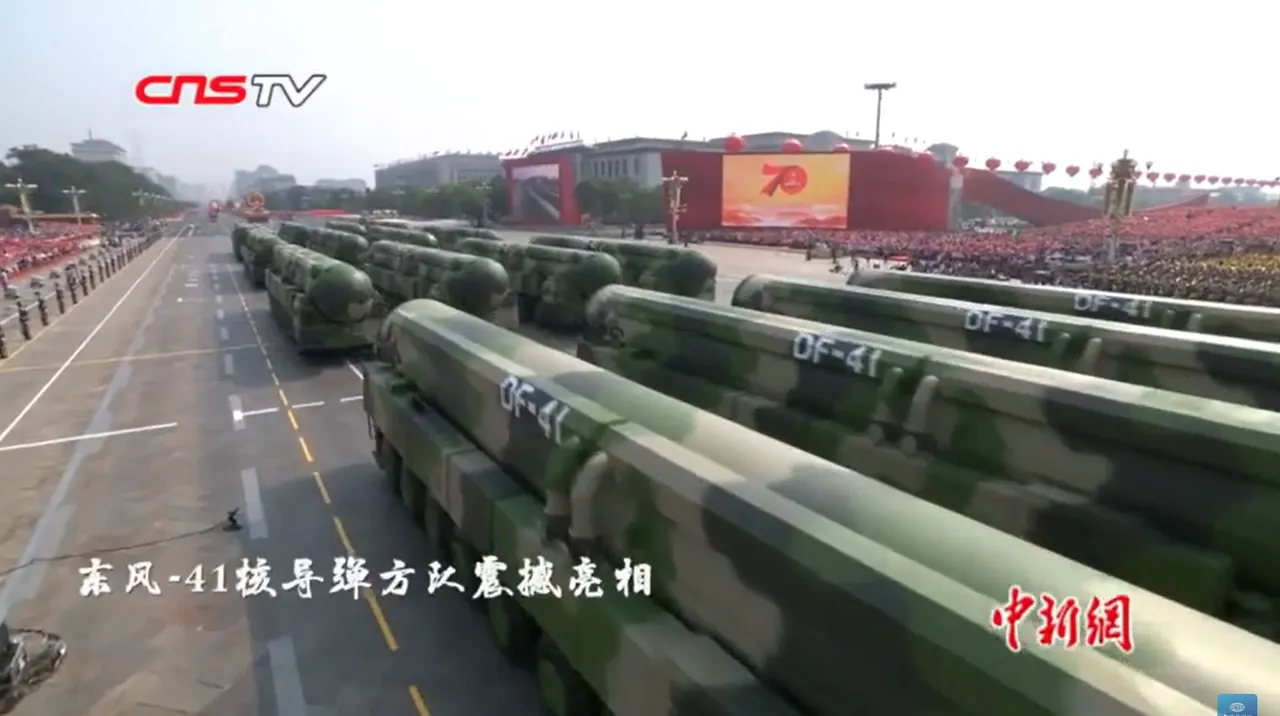
Chinese state television reported on 5 November 2026 that the PLA Rocket Force has put the DF-61, its newest land-based intercontinental ballistic missile, into routine training, about 14 months after the missile was first shown at a military parade in Beijing in September 2025. The report, timed to the 66th anniversary of China's first successful ballistic missile launch, did not give the missile's range, performance, numbers or where it is based.
A commentator quoted by the broadcaster, Shao Yongling, who has worked as a Rocket Force researcher, said the step came far faster than for earlier ICBMs. He said the missile had finished development, design finalisation, trial fielding and reliability checks before it was unveiled, and that routine training covers field manoeuvres, moving between launch positions and launch procedures. These are Chinese claims and have not been independently verified.
The argument
Much of the attention has gone to the speed of the timeline. For Taiwan, that is the less useful question. The public evidence that China has become faster at building new ICBMs is thin. The evidence that it is making its land-based nuclear force harder to find and destroy is stronger, and that is the part that bears on a war over Taiwan.
Evidence and constraints
Ankit Panda of the Carnegie Endowment told the South China Morning Post on 8 November that earlier Chinese ICBMs generally took far longer to enter service and that the DF-61 does appear notably quicker, but he added that there is not enough public information on its development and testing. His colleague Tong Zhao noted that the DF-31 was shown in 1999 but is widely believed to have entered service only around 2006, while the DF-41 went through reported flight tests from 2012 to 2018 before its 2019 parade debut.
The likeliest explanation for the speed is family resemblance. Mackenzie Knight-Boyle of the Federation of American Scientists told the newspaper that the DF-61 and DF-41 use nearly identical launchers and missile canisters, and that the quick progress would make sense if the new missile is a modified DF-41 rather than a new design. She said it could not be assumed that the Rocket Force has become faster at developing ICBMs. The EurAsian Times also noted that many commentators treat the DF-61 as a variant or upgrade of the DF-41.
Key numbers remain unknown. China has not disclosed the DF-61's range or warhead load. The Post cited earlier estimates of 12,000 to 15,000 kilometres, while the defence intelligence firm Janes has estimated a maximum of about 18,000 kilometres and up to 12 warheads. The EurAsian Times said Chinese commentators have put the range at 18,000 kilometres without official confirmation.
Entering service is also not the same as full readiness, which needs trained crews, launch vehicles and infrastructure. A former US intelligence analyst told the Post he had not yet seen satellite imagery confirming an operational DF-61 unit. Separately, the Post reported on 6 November that state media used the same anniversary to show the rarely seen DF-100 cruise missile, as social media reports suggested a possible inland ICBM test that has not been officially confirmed.
What could change
Several developments would sharpen this picture. Satellite imagery of a garrison or brigade equipped with the DF-61 would show that fielding has moved beyond training. A confirmed flight test, or an official account of the missile's development record, would show whether it is a new design or an upgraded DF-41. Clearer official estimates of range and warheads would show whether it adds reach or mainly adds survivable launchers to an existing mission.
Why it matters
The analysts quoted by the Post disagreed on the consequences. David Logan of Tufts University said China's increasingly survivable nuclear forces could embolden Beijing to use military force by reducing its vulnerability to a US nuclear first strike, but could also lower the risk of unintended escalation by easing fears of losing its weapons early in a crisis. Panda said systems like the DF-61 may increase US uncertainty about China's ability to scale and shape its strategic force.
For Taiwan, the second effect deserves as much attention as the first. A road-mobile ICBM force that practises dispersing and changing launch sites is aimed at keeping a retaliatory capability alive, and that weakens any assumption that nuclear escalation risk would weigh more heavily on Beijing than on Washington in a cross-strait war. It does not change the conventional balance in the Taiwan Strait, where the Rocket Force's shorter-range missiles matter more directly. But it means the useful measure for Taipei is how survivable China's nuclear force is becoming, not how quickly a parade missile reaches a training ground.
Sources
More in Analysis
Why the November 2026 F-16 weapons report matters more for Taiwan than the new jets' arrival
A defence ministry report covered on 9 November 2026 shows Taiwan's new F-16s will fly for years before their glide bombs and jamming pods are complete.
TaiwanDefence · 13h ago · 4 min read
Why the Fujian carrier's 5 November first anniversary matters more for Taiwan than China's combat claims
China marked the Fujian carrier's first year in service on 5 November 2026; its repeated passages around Taiwan matter more than claims of full combat power.
TaiwanDefence · 17h ago · 4 min read
Why China's 5 November TB-001 drone flight past Okinawa matters for Taiwan's eastern flank
China flew an attack-capable TB-001 drone toward Japan's Danjo Islands on 5 November 2026, one of several recent drone loops that also skirt Taiwan's east side.
TaiwanDefence · 18h ago · 3 min read
Discussion (0)
Comments are not currently available.